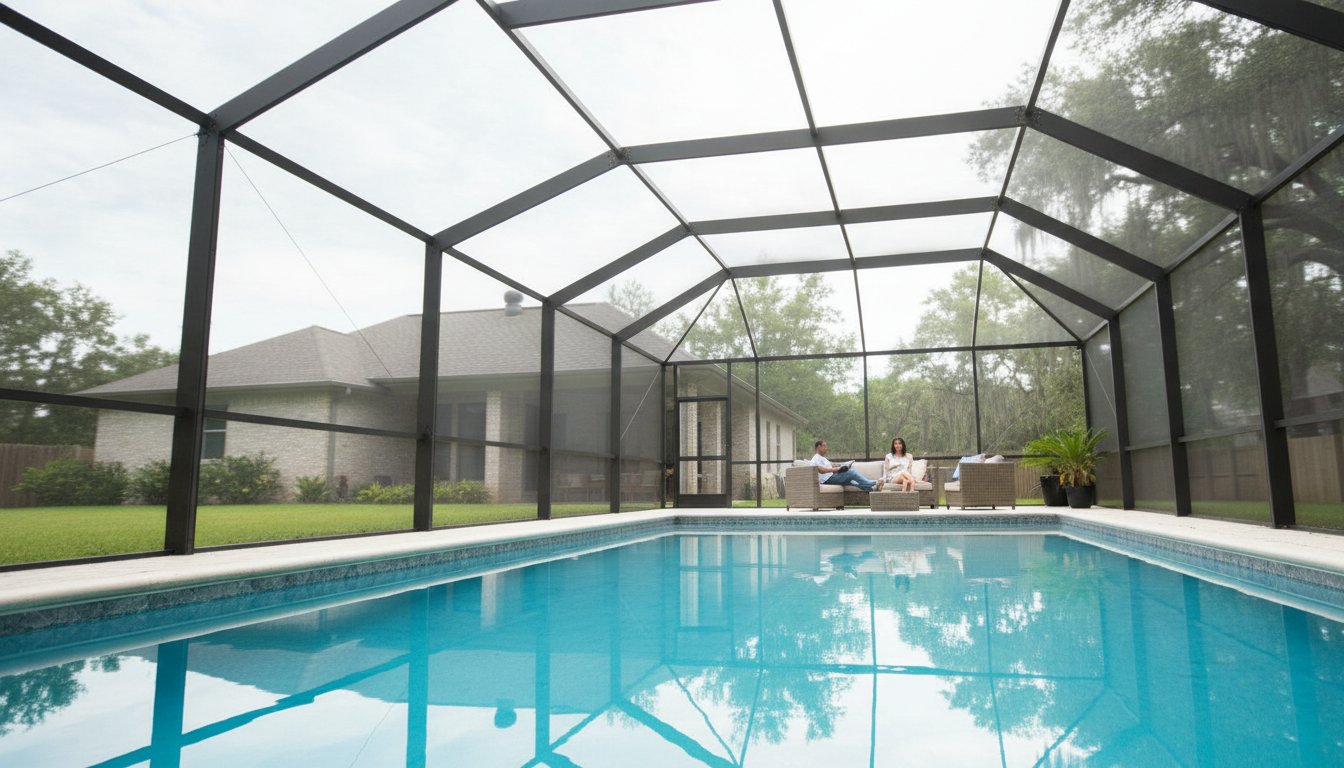
Is your pool enclosure a reliable sanctuary or just a ticking clock waiting for the next Gulf Coast storm to tear through it? Many homeowners assume all mesh is created equal until they’re faced with sagging panels, mold growth, or a quote that doesn’t seem to add up. When you’re calculating the pool screen replacement cost for your home, it’s easy to feel overwhelmed by technical jargon and the fear of choosing a material that won’t survive a single humid summer. You deserve a clear path to a durable, bug-free outdoor space without the usual guesswork.
We understand that your enclosure is a significant investment in your home’s structural preservation and your family’s comfort. This guide provides the clarity you need to navigate 2026 Gulf Coast standards; we cover everything from wind-load engineering to selecting high-performance mesh that stands up to intense UV rays. We’ll explore the specific factors that drive project expenses and compare the longevity of standard fiberglass against premium options like no-see-um and solar screens. By the end, you’ll have the confidence to choose a solution that delivers both aesthetic harmony and lasting protection for your backyard retreat.
Key Takeaways
- Identify how enclosure dimensions and roof styles like Mansard designs directly influence your pool screen replacement cost.
- Compare the long-term value of standard fiberglass against high-durability polyester mesh designed to withstand Gulf Coast storm seasons.
- Learn to spot the early warning signs of mesh failure, including UV-induced silvering and spline creep, before they lead to structural issues.
- Understand the technical precision required for proper spline tensioning and the safety risks involved with working on high-pitched roof panels.
- Discover why regional expertise and site-specific engineering are essential for maintaining a resilient, professional-looking pool area in high-humidity climates.
Key Variables Influencing Pool Screen Replacement Cost
Every homeowner eventually faces the reality that their enclosure mesh has a finite lifespan. Determining the pool screen replacement cost for your specific property requires a look at several structural factors beyond the mesh itself. While the total square footage of the walls and roof panels provides a baseline, the physical layout of your backyard often dictates the final investment. We view every rescreening as a precision project where the following variables play a critical role:
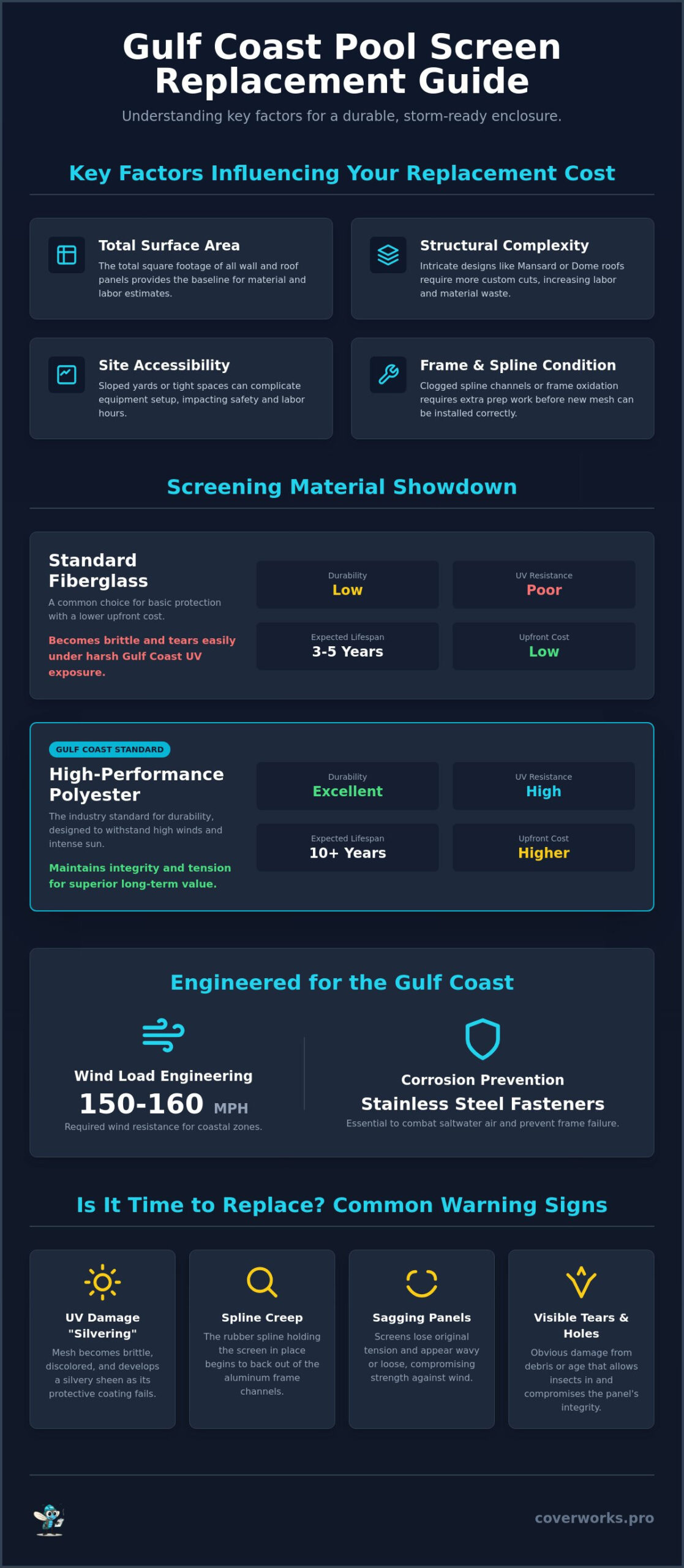
- Total Surface Area: This includes the cumulative measurement of all vertical wall panels and the overhead roof sections.
- Structural Complexity: The shape of your enclosure, such as a standard Gable or a more intricate Mansard design, affects how much material is wasted during custom cutting.
- Accessibility and Terrain: Technicians need stable ground to stage ladders and safety equipment. Sloped yards or tight spaces between the enclosure and a fence can increase labor hours.
- Frame and Spline Integrity: The condition of the existing aluminum frame is paramount. If the spline channels are clogged with debris or the frame is oxidized, additional prep work is required before new mesh can be installed.
While a standard screened porch might be straightforward, a full pool enclosure involves significant engineering that must be respected during the rescreening process.
Size and Structural Complexity
Multi-story enclosures or those with high-vaulted ceilings require specialized safety equipment and additional labor to ensure every panel is tensioned correctly. Mansard or Dome roofs significantly increase labor time due to the intricate angled cuts required to fit the mesh into each custom-shaped panel. Increased height directly elevates labor risk and insurance premiums, as technicians must utilize specialized scaffolding or safety harnesses for multi-story structures. This precision ensures your enclosure doesn’t just look better, but remains structurally sound against the elements.
Regional Climate and Engineering Requirements
In the Gulf Coast, your screen does more than keep out pests; it acts as a wind-break. Local building codes in Louisiana and Alabama coastal zones often require enclosures to meet wind-load requirements in the 150 to 160 mph range. This means the mesh must be secured with the correct spline weight to prevent it from blowing out during a tropical system. Proximity to saltwater also necessitates a close inspection of your hardware. We often find that upgraded stainless steel fasteners are required during a rescreen to prevent corrosion from compromising the aluminum frame. For those considering a completely new structure, our Custom Pool Enclosure Installation in Louisiana guide offers deeper insights into the building process. Understanding these regional factors is essential for calculating an accurate pool screen replacement cost that delivers long-term durability.
Comparing Screening Materials: Performance vs. Long-Term Value
Selecting the right mesh is the most critical decision you’ll make when evaluating your pool screen replacement cost. While the aluminum frame provides the skeleton, the screen material dictates how often you’ll need to revisit this project. Homeowners often choose between immediate savings and long-term resilience. Standard fiberglass remains the most common entry-level option, offering basic insect protection and decent visibility. However, in the intense heat of the Gulf Coast, fiberglass can lose its flexibility within just a few years. For those seeking a more permanent solution, polyester mesh has become the industry standard for durability, especially in regions prone to high winds and heavy tropical downpours.
Material Durability in High-Humidity Environments
Southern UV exposure is notoriously harsh on synthetic materials. Standard fiberglass mesh often becomes brittle and “silvery” as the protective coating breaks down, making it susceptible to tearing during minor storms. High-tenacity polyester mesh resists this degradation far more effectively. In Alabama summers, where humidity and heat create a punishing environment, polyester maintains its structural integrity and tension much longer than its fiberglass counterparts. Choosing a more resilient material can significantly lower the effective pool screen replacement cost over the life of your enclosure by extending the time between rescreening cycles.
| Material Type | Cost Tier | Estimated Lifespan | Best Use-Case |
|---|---|---|---|
| Standard Fiberglass | Economy | 3 to 5 Years | Budget-conscious projects |
| Polyester Mesh | Premium | 10 to 15+ Years | High-wind zones and longevity |
| Pet-Resistant | Specialized | 7 to 10 Years | Active pets or high-impact areas |
Specialty Mesh for Lifestyle Needs
Homeowners located near Louisiana marshes or Mississippi bayous often require “No-See-Um” mesh. This 20×20 weave is fine enough to block the tiny biting gnats that standard 18×14 mesh might miss. If your pool deck feels like a furnace, solar mesh can reduce heat gain and UV exposure, creating a more comfortable microclimate. These specialized materials often complement other upgrades, such as Lexan and polycarbonate roofs, which provide total protection from rain and sun. When vetting materials and contractors, it’s wise to review official advice on how to avoid a home improvement scam to ensure you’re getting the quality you pay for. Choosing the right material ensures your backyard remains a sanctuary of aesthetic harmony and functional comfort. If you’re ready to see which mesh fits your lifestyle, explore our professional rescreening options today.
The Hidden Risks of DIY vs. Professional Rescreening
While the initial pool screen replacement cost might seem lower if you tackle the job yourself, the technical demands of a full rescreen often lead to hidden expenses. Most homeowners see the mesh as the only variable, but the tension applied during installation is actually a structural calculation. Unlike the minor pool screen enclosure costs associated with a small patch repair, a full rescreen requires a level of precision that preserves the aluminum frame for the long term. A DIY attempt often results in sagging panels or, worse, a warped frame that requires expensive professional correction.
Structural Integrity and Frame Preservation
Improper tensioning is the most common mistake in amateur projects. If the mesh is pulled too tightly, it can actually cause aluminum members to bow or pull out of alignment, compromising the entire structure. Our Master Craftsman approach involves a comprehensive inspection of every fastener and anchor point before the first roll of mesh is even opened. We often find that older enclosures have loose anchors or oxidized screws that need replacement to maintain structural integrity. The quality of the spline, the rubber cord that locks the screen into the channel, is just as important as the mesh itself; using the wrong size or a low-grade material leads to “spline creep” and premature failure.
Safety and Liability Considerations
The physical risk of working on a pool cage is substantial. Professionals utilize fall protection and specialized staging to navigate high-pitched enclosure roofs, whereas a DIYer often resorts to “walking the beams.” This practice is incredibly dangerous and can lead to catastrophic falls or structural collapse if the beam isn’t rated for point-load weight. Beyond physical safety, using uninsured day labor or attempting it yourself carries significant liability risks. If an accident occurs on your property, you could be held responsible for medical costs and legal fees.
Professional crews operate with full insurance and the efficiency to complete a project in days, whereas a solo effort might drag on for weeks, leaving your pool exposed to debris and pests. Accessing commercial-grade materials, which aren’t available at big-box retail stores, ensures your investment withstands the next Gulf Coast storm season. When you weigh the potential for frame damage against the upfront pool screen replacement cost, the value of a professional labor guarantee becomes clear. You’re not just paying for new mesh; you’re paying for the structural preservation of your outdoor living space. To ensure you’re partnering with qualified professionals, our guide on choosing the right screen builders for Gulf Coast homeowners can help you identify the craftsmanship and credentials that matter most.
The Rescreening Checklist: When to Invest in Your Enclosure
Recognizing the exact moment your enclosure has reached its limit is essential for protecting your property. While it’s tempting to delay the pool screen replacement cost, waiting until a total failure occurs often leads to more expensive frame repairs. A healthy enclosure should be a taut, uniform barrier. If you notice any of the following indicators, your mesh is likely nearing the end of its functional life. Our detailed pool enclosure mesh replacement checklist for 2026 can help you systematically evaluate each of these warning signs before they escalate into structural problems.
- Visible ‘Silvering’: This silvery or bleached appearance is a clear sign of UV damage. It indicates the protective coating has evaporated, leaving the fiberglass core vulnerable to the elements.
- Spline ‘Creep’: Look at the channels where the mesh meets the aluminum. If the screen is pulling away or the rubber spline is popping out, the material has lost its elasticity.
- Organic Penetration: In our humid climate, algae or lichen can actually grow into the weave of the mesh. This doesn’t just look poor; it physically weakens the fibers.
- The Finger-Poke Test: Gently press your finger against a sun-exposed panel. If the mesh feels brittle or produces a “crunching” sound, it’s ready for replacement.
Identifying Storm and Wind Damage
Small tears might seem minor, but they act like a perforated line on a sheet of paper. During high winds, these small openings allow pressure to build up inside the enclosure, often leading to a catastrophic blowout of multiple panels. We recommend checking your corner bracing and door hardware annually. If you find several damaged sections, remember that partial rescreening is often a false economy. The labor required to set up equipment for three panels is nearly the same as a full rescreen, and the older, remaining mesh will likely fail shortly after the new sections are installed.
Scheduling for Peak Performance
Timing your project can improve both the installation quality and your overall experience. Spring and autumn are the ideal windows for rescreening in Mississippi and across the Gulf Coast. The moderate temperatures allow the mesh to be pulled to the perfect tension without the extreme thermal expansion seen in mid-July. Before our crew arrives, ensure the pool deck is clear of furniture and potted plants. This allows for a safer, more efficient workflow. Many homeowners choose to pair their rescreening with Decorative Concrete & Kool Deck Resurfacing to achieve a total backyard transformation in a single service window. If you’re seeing signs of wear and want an expert’s eyes on your structure, request a professional enclosure assessment to secure your home before the next storm season.
CoverWorks: Precision Rescreening for the Gulf Coast
When you evaluate the pool screen replacement cost for your home, the value of regional experience cannot be overstated. A pool enclosure is a complex architectural feature that must withstand some of the most challenging weather conditions in the United States. With over 20 years of specialized experience serving homeowners across Louisiana, Mississippi, and Alabama, CoverWorks Inc. brings a deep understanding of local building codes and environmental stressors to every project. We don’t just replace mesh; we restore the structural integrity and aesthetic harmony of your outdoor living space.
Our expertise extends to the most difficult structural designs, including the intricate Mansard roofs and multi-story enclosures that require site-specific engineering. We recognize that a sagging screen or a loose spline is often a symptom of larger structural needs. By focusing on precision and utilizing high-performance materials, CoverWorks Inc. ensures that your rescreening project provides a lasting return on investment. Our goal is to provide a clear, competitive pool screen replacement cost while ensuring the resulting structure remains a point of pride for your property for years to come.
The CoverWorks Inc. Difference: Quality and Speed
We position ourselves as the Master Craftsman of outdoor aluminum structures. This means we never cut corners on material quality or installation techniques. Every roll of mesh we use is specifically selected for its ability to resist the intense Southern humidity and UV exposure that typically degrades standard retail products. We respect your time and your property. Our refined workflow allows CoverWorks Inc. to offer a same-day quote process, providing the information you need to make an informed decision without unnecessary delays. This proactive approach ensures that your backyard remains a sanctuary rather than a construction zone for weeks on end.
- Regional Familiarity: Deep knowledge of coastal wind-load requirements and saltwater corrosion challenges.
- Structural Accuracy: Specialized techniques for tensioning Mansard and vaulted roof panels without warping the frame.
- Comprehensive Care: Ability to pair rescreening with Decorative Concrete & Kool Deck Resurfacing for a complete aesthetic upgrade.
- Efficiency: Professional crews equipped with the safety gear and tools to complete high-pitched roof work safely and quickly.
Get Started on Your Backyard Transformation
Protecting your home investment starts with a professional assessment of your enclosure’s current state. Whether you are dealing with storm damage or simply want to upgrade to a high-performance mesh that keeps out the smallest pests, CoverWorks Inc. is here to act as your reliable guide. A well-maintained enclosure enhances your lifestyle, improves your home’s curb appeal, and provides a bug-free environment for your family to enjoy. Don’t wait for the next major storm to test the limits of brittle, aged mesh. We invite you to begin your transformation today with a consultation that focuses on durable results and functional beauty.
Request your same-day rescreening quote from CoverWorks Inc. and take the first step toward a revitalized outdoor sanctuary.
Secure Your Backyard Sanctuary for the Seasons Ahead
Your pool enclosure is the primary shield protecting your family’s comfort and your property’s value. We’ve examined how structural complexity and high-performance material choices dictate the long-term success of any rescreening project. By prioritizing durability over temporary fixes, you ensure your outdoor space remains a source of relaxation rather than a maintenance burden. Choosing the right mesh and ensuring precise tensioning are the most effective ways to safeguard your structure against the intense Southern sun and seasonal storms.
Understanding your pool screen replacement cost is the first step toward a more resilient home that can withstand the unique environmental pressures of the Gulf Coast. CoverWorks Inc. brings over 20 years of local experience to every project, specializing in complex Mansard roofs and custom aluminum structures. We value your time and offer same-day quotes to provide the clarity you need to move forward with confidence. Schedule your professional pool cage rescreening with CoverWorks Inc. today to restore the structural integrity and aesthetic harmony of your backyard. We look forward to helping you create a bug-free retreat that’s built to last.
Common Questions About Pool Screen Replacement
Is it better to replace one screen panel or the entire pool cage?
Replacing the entire enclosure is usually the most cost-effective decision if your mesh is more than five years old. While a single panel fix addresses an immediate hole, the labor costs for a service call are high relative to the material used. Most homeowners find that once one panel fails from UV brittleness, the rest of the enclosure follows within a few months, leading to multiple repair bills.
How long does a typical pool screen replacement take to complete?
A professional rescreening project typically takes between one and three days for a standard-sized enclosure. Larger structures or complex Mansard roofs may require additional time for precision cutting and specialized safety staging. Our crews work efficiently to minimize the time your pool area is exposed to the elements, though Gulf Coast weather patterns can occasionally influence the timeline.
Does homeowners insurance cover the pool screen replacement cost after a storm?
Coverage for a pool screen replacement cost often depends on whether your policy includes a specific rider for “Other Structures.” Many standard policies in Louisiana and Alabama have high deductibles for wind damage or may exclude screen enclosures entirely. It’s best to consult your insurance agent before storm season to verify your current level of protection for outdoor aluminum structures.
What is the strongest screen material for homes with pets or children?
Polyester-reinforced mesh is the most durable choice for households with active pets or small children. This material is significantly thicker than standard fiberglass and is engineered to withstand scratching, clawing, and accidental impacts. Many homeowners choose to install this heavy-duty mesh on the lower “chair rail” panels while using standard mesh for the roof to balance visibility and structural strength.
How often should a pool enclosure be rescreened in the Gulf Coast region?
You should plan to rescreen your enclosure every seven to ten years to maintain its structural integrity. The intense humidity and UV rays in our region break down the protective coating on fiberglass mesh much faster than in dryer climates. Choosing high-tenacity polyester mesh can extend this window to fifteen years or more, providing superior long-term value for your investment. To better understand the specific warning signs that indicate it’s time to act, review our guide on scheduling a pool enclosure mesh replacement before the next hurricane season.
Can I change the type of mesh during a rescreening project?
Rescreening is the perfect opportunity to upgrade your mesh type to better suit your lifestyle needs. You can switch from standard fiberglass to no-see-um mesh for better bug protection or solar mesh to reduce heat gain without modifying the aluminum frame. This customization allows you to solve specific problems like tiny biting gnats or uncomfortable deck temperatures during a single project window.
Will rescreening my pool enclosure help keep the water cleaner?
Intact screens act as a critical barrier against organic debris that can disrupt your pool’s chemistry. New mesh effectively blocks leaves, pine needles, and heavy pollen that would otherwise clog your filtration system and lead to algae growth. By keeping these contaminants out, you reduce the workload on your pool pump and can significantly lower your monthly chemical expenses.
Does the color of the screen affect the temperature of the pool area?
While dark charcoal mesh is the industry standard for superior visibility, only specialty solar mesh significantly lowers the temperature. These specific screens are engineered to reflect a portion of the sun’s infrared heat before it reaches your pool deck. This can make the microclimate inside your enclosure noticeably cooler and more comfortable during the peak of a Mississippi summer.
Leave a Reply