Tag: Kool Deck

  • 5 Best Decorative Concrete Patio Finishes for Gulf Coast Homes (2026)

    5 Best Decorative Concrete Patio Finishes for Gulf Coast Homes (2026)

    A stunning outdoor living space shouldn’t come with the risk of burned feet or a slippery trip to the pool. In the sweltering humidity of New Orleans and the salt air of Gulfport, standard slabs often fail, cracking under thermal expansion or becoming dangerously slick. Choosing the right decorative concrete patio finishes is about more than just aesthetics; it’s a strategic decision to protect your investment against the Gulf Coast’s relentless climate. Whether you are trying to hide an ugly existing slab or finishing a new pool deck, the material you choose must handle the unique environmental stresses of the South.

    We understand that you want a custom look that doesn’t require a weekend of scrubbing or a gallon of sealant every year. You deserve a surface that stays comfortable in the August heat and stands up to heavy rain without losing its grip. In this guide, we’ll explore five professional-grade finishes that deliver high-end style without compromising on durability or safety. You’ll discover how specialized applications like Kool Deck and textured overlays can transform your backyard into a low-maintenance retreat that meets local building standards and enhances your home’s value across Louisiana, Mississippi, and Alabama.

    Key Takeaways

    • Learn why specialized finishes are essential for protecting your slab against the high humidity and salt air found in coastal areas like New Orleans and Gulfport.
    • Compare the pros and cons of the top five decorative concrete patio finishes, including stamped patterns and exposed aggregate, to find the best fit for your home’s style.
    • Discover which coatings effectively lower surface temperatures and provide superior slip resistance for family-friendly pool areas.
    • Use our homeowner’s evaluation framework to determine if your current patio is a candidate for resurfacing or requires structural repairs first.
    • Understand how professional sealing and proper engineering ensure your new patio finish survives the region’s intense thermal expansion.

    Why Decorative Concrete Patio Finishes Matter for Your Home

    Many homeowners view decorative concrete finishes as a purely cosmetic upgrade, but for those of us living along the Gulf Coast, it’s a vital structural investment. These systems act as a protective layer for your concrete slab, shielding it from the elements while providing a custom aesthetic. In high-demand markets like Slidell and Metairie, a professionally finished patio is a significant value-add for home resale. Buyers in our region look for outdoor spaces that are move-in ready and built to last, rather than a stained, gray slab that looks like an unfinished project. Choosing the right decorative concrete patio finishes ensures your home stands out for all the right reasons.

    Standard gray concrete often fails to meet the needs of Southern homeowners because it lacks “thermal comfort.” Untreated concrete absorbs an immense amount of solar energy, often reaching temperatures that make it impossible to walk on without shoes. Beyond the heat, our humid climate creates a constant battle with water intrusion. Without a proper finish, moisture seeps into the pores of the concrete, leading to surface spalling and unsightly flaking. A professional finish seals those pores, preventing water from compromising the integrity of the material and keeping your patio looking pristine through every hurricane season.

    Beyond Aesthetics: Protection and Safety

    Rainy afternoons are a fact of life in New Orleans and the surrounding areas. Textured decorative concrete patio finishes provide the essential grip needed to keep your family safe on wet surfaces. These textures aren’t just for show; they create a slip-resistant profile that is critical for pool decks and high-traffic walkways. We also prioritize the use of high-quality sealants that inhibit the growth of mold and mildew, which thrive in our 90 percent humidity levels. Decorative resurfacing is a cost-effective alternative to the massive expense and mess of full slab replacement.

    The Gulf Coast Factor: Concrete vs. Humidity

    Our region presents unique challenges that Northern construction guides simply don’t address. While those guides focus on freeze-thaw cycles, we have to account for salt air corrosion and exceptionally high water tables. Standard finishes often peel or bubble because they can’t breathe or handle the constant moisture rising from the ground. We use UV-stable pigments that won’t fade or “chalk” under the intense Alabama sun, ensuring your color remains vibrant for years. It’s a specialized approach that respects the local environment while delivering a result that holds up against the relentless heat and salt spray of the coast.

    Top 5 Decorative Concrete Finishes for Modern Patios

    Selecting from the available decorative concrete patio finishes requires balancing your personal style with the functional demands of the Gulf Coast. While some finishes focus on high-end visuals, others prioritize the safety of your family or the longevity of the slab itself. We’ve narrowed down the best options that stand up to our local environment while delivering a custom, high-quality result. At CoverWorks Inc., we specialize in applying these systems to ensure they meet both building codes and your aesthetic goals.

    Stamped Concrete: The Classic Versatile Choice

    Stamped concrete allows homeowners to replicate the appearance of expensive natural stone, slate, or even rustic wood planks using a single, solid slab. This method provides the high-end look of individual pavers without the risk of stones shifting or weeds growing through joints over time. In Louisiana and Mississippi, patterns like Ashlar Slate and European Fan are particularly popular for their timeless appeal and ability to complement traditional architecture. However, it’s important to recognize that stamped surfaces can become slippery when wet. To prevent this, we always recommend incorporating non-slip additives into the final sealant to ensure a safe grip during our frequent afternoon downpours.

    Kool Deck: The Ultimate Heat Solution

    For many of our clients, the primary goal for a patio is temperature control. Kool Deck is the industry standard for cooling coatings, specifically engineered to lower surface temperatures by up to 20 degrees compared to traditional gray concrete. It’s the preferred choice for kool deck resurfacing pool deck projects because it remains comfortable for bare feet even during a Biloxi summer. To keep this cooling coating in top shape, you should perform regular cleaning with a mild detergent. Maintaining the solar-reflective properties requires following a consistent resealing schedule, which protects the specialized pigments from UV degradation.

    Beyond these two popular choices, there are three other finishes that offer unique benefits for Gulf Coast homes:

    • Exposed Aggregate: This rugged finish reveals the natural stones within the concrete. It provides excellent traction and is highly resistant to heavy foot traffic, making it ideal for walkways.
    • Stained Concrete: Perfect for a sophisticated, marbled look. Stains penetrate the surface to create deep, translucent colors that won’t peel like topical paints.
    • Broom and Trowel Textures: A modern, minimalist approach. These finishes offer a clean look with a subtle texture that is both functional and cost-effective.

    If you aren’t sure which of these systems fits your current outdoor layout, our team at CoverWorks Inc. can help you evaluate your slab and choose a finish that aligns with your home’s structural needs and architecture.

    Performance Factors: Heat, Humidity, and Slip Resistance

    A patio that looks beautiful in January can become a liability by July if the performance factors aren’t correctly managed. In our region, the selection of decorative concrete patio finishes must prioritize local environmental stressors like intense solar radiation and high annual rainfall. Choosing a finish based solely on a catalog photo often leads to surfaces that are too hot to walk on or dangerously slick after a typical Gulfport thunderstorm. We focus on the engineering behind the aesthetics to ensure your outdoor space remains functional year round.

    One of the biggest mistakes homeowners make is choosing dark, heavy stains for unshaded areas. Darker colors absorb significantly more thermal energy, which can cause the concrete to reach temperatures exceeding 140 degrees. In contrast, light colored cooling coatings reflect solar energy rather than storing it. This difference is vital for maintaining structural integrity, as excessive heat contributes to faster expansion and potential cracking in the slab. Additionally, we must consider UV stability. Integral coloring, where the pigment is mixed throughout the concrete, typically resists fading better than topical stains that sit on the surface and face the direct brunt of the Alabama sun.

    Managing Surface Temperatures

    The science of light reflectance is the key to a comfortable deck. By choosing materials with high solar reflectance, you can significantly reduce the “heat island” effect in your backyard. If you’re struggling with a scorching slab, there are several ways to begin cooling patio deck surfaces. While dark stamped concrete provides a sophisticated look, it is often impractical for unshaded Alabama patios where bare feet are common.

    Safety and Traction Standards

    Safety is often measured by the “coefficient of friction,” which is a technical way of describing how much grip a surface provides. A higher number means better traction. For high traffic pool areas in New Orleans, we often mix anti-skid additives directly into the final sealer. These fine, transparent granules provide essential grip without altering the color of your decorative concrete patio finishes. Proper drainage is also a non negotiable requirement in high rainfall areas like Biloxi. We ensure your patio is pitched correctly so that water clears the surface quickly, preventing the growth of slippery algae and standing puddles.

    Choosing the Right Finish: A Homeowner’s Evaluation Framework

    Selecting the ideal decorative concrete patio finishes involves more than just picking a color you like from a brochure. It requires a systematic look at your current outdoor space, your lifestyle needs, and your long term budget. For example, a family with young children in Metairie will likely prioritize slip resistance and temperature control over the deep, glossy finish of a premium stained slab. Conversely, a property manager in Slidell might look for the most durable, low maintenance option to withstand heavy foot traffic and frequent pressure washing. Every project starts with a clear understanding of what the space must achieve on a daily basis.

    Your budget will also dictate the complexity of the project. Basic broom or trowel textures are highly functional and cost effective, while multi color stamped patterns that replicate natural slate fall into the premium category. It’s also vital to consider how your new floor will look alongside existing structures. A common mistake is ignoring the visual relationship between the ground and the roof. We often recommend coordinating the texture and tone of your patio with custom aluminum patio covers Mississippi to create a cohesive outdoor room that feels like a natural extension of your home’s architecture. This integrated approach ensures your decorative concrete patio finishes don’t clash with your structural upgrades.

    The ‘New vs. Old’ Decision

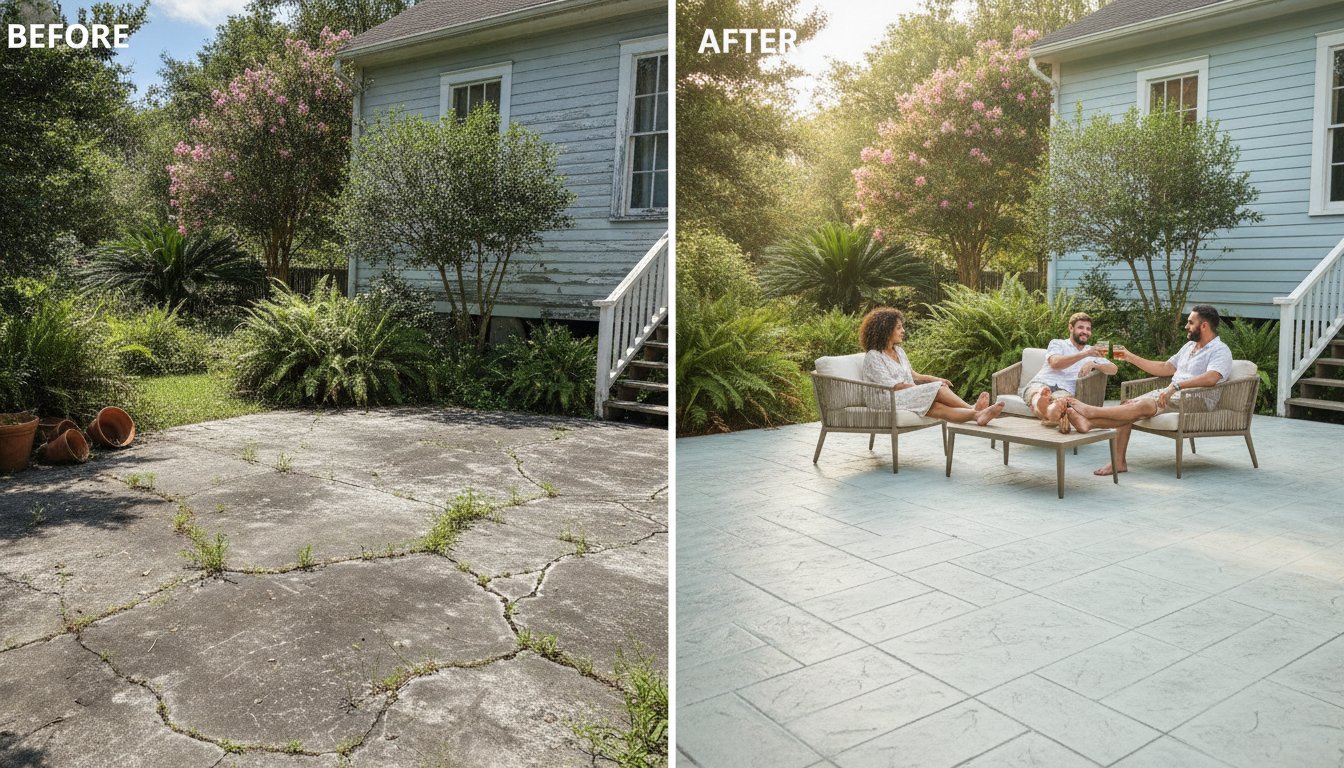
    Before applying any finish, you must determine if your slab is structurally sound. Superficial cracks, minor spalling, and stains are perfect candidates for a decorative overlay. However, if the concrete is sinking, shifting, or has wide settlement cracks that indicate a compromised base, a new pour might be necessary. Professional decorative concrete resurfacing contractors can save homeowners thousands over full replacement by repairing the surface and applying a durable new finish. Signs of structural failure, like deep heaving or large chunks of missing concrete, are warnings that decorative finishes alone cannot hide.

    Matching Style to Architecture

    Coordinating your concrete colors with your home’s siding and trim creates a polished, intentional look. You don’t necessarily want an exact match; instead, look for complementary tones that tie the space together. Using decorative borders or bands is an excellent way to define specific rooms within a large patio, such as a dining area or a sunbathing zone. If you have a specific architectural feature, like a Mansard roof pool enclosure, choosing a pattern with clean, geometric lines often works better than a rustic, irregular stone texture. This level of detail is what separates a standard backyard from a professionally designed outdoor living area.

    Transform Your Patio with CoverWorks Professional Resurfacing

    Most online guides assume you are starting with a fresh pour of concrete, but the reality for most homeowners in New Orleans and Gulfport is much different. You likely have an existing slab that is structurally sound but looks weathered, stained, or outdated. At CoverWorks Inc., we specialize in the art of resurfacing, bringing over 25 years of field experience to every project. We don’t just apply decorative concrete patio finishes; we restore the integrity of your outdoor living space. Our team understands how the salt air and intense humidity of the Gulf Coast affect material longevity, and we use that knowledge to ensure your investment lasts for decades.

    Our “Master Craftsman” approach means we prioritize engineering and structural health before we ever think about aesthetics. We’ve spent over two decades building aluminum specialty structures and finishing concrete across Louisiana, Mississippi, and Alabama. This dual expertise allows us to seamlessly integrate your patio finish with existing pool enclosures or screen rooms. We ensure that every project meets local building codes and wind load requirements, providing a level of reliability that general contractors often overlook. From Mobile to Slidell, our goal is to move you from a functional need to a vision of improved comfort and style.

    Our Specialized Resurfacing Process

    The secret to a finish that doesn’t peel or bubble in our climate lies in the preparation phase. We begin with a thorough mechanical cleaning and surface profiling to ensure the new overlay creates a permanent bond with the original slab. Once the foundation is ready, we move into custom color blending. This allows us to create a one-of-a-kind look that complements your home’s unique architecture. The final step is the application of a high-grade, UV-stable sealant. This protective layer is what guards your decorative concrete patio finishes against the relentless sun and frequent rain, keeping the colors vibrant and the surface easy to maintain.

    Get Your Free Estimate Today

    Taking the first step toward a beautiful backyard shouldn’t be a stressful experience. We respect your time and expectations, which is why we offer same-day quotes for most residential projects. When you schedule a professional site consultation, one of our seasoned experts will visit your property in communities like Metairie or Biloxi to perform a detailed slab evaluation. We’ll discuss your goals for heat control and slip resistance while providing a clear, honest assessment of what is possible for your specific space. There are no high-pressure sales tactics; just a steady, helpful delivery of facts and solutions. Contact CoverWorks Inc. today to begin your patio transformation with a team that values precision and functional beauty.

    Build a Backyard Built to Last

    Your outdoor living space should be a source of relaxation, not a maintenance burden or a safety hazard. By selecting from the most durable decorative concrete patio finishes, you ensure your home stays comfortable during the peak of summer and safe during our frequent rainstorms. Whether you opt for the cooling properties of Kool Deck or the timeless look of stamped stone, the right choice protects your slab while elevating your property’s curb appeal across the Gulf Coast.

    At CoverWorks Inc., we bring over 25 years of field experience to every project. We are fully licensed and insured across Louisiana, Mississippi, and Alabama, specializing in surfaces and structures designed to withstand our unique regional wind loads and humidity. As specialists in hurricane resistant structures, we understand that building for our climate requires a commitment to structural integrity that goes far beyond the surface level.

    We look forward to helping you transform your existing slab into a custom retreat that your family can enjoy for years to come. Let’s build something beautiful and durable together.

    Frequently Asked Questions

    Is stamped concrete too slippery for a pool deck?

    Stamped concrete provides excellent traction when installed with slip-resistant additives. We mix specialized anti-skid granules into the final sealant layer to ensure a safe grip, even when the surface is wet from a pool or rain. Without these additives, the smooth surface of some decorative concrete patio finishes can become slick, so it’s vital to work with a contractor who understands local safety needs.

    How long do decorative concrete finishes typically last?

    A professionally applied finish can last between 10 and 15 years with proper care. The lifespan depends heavily on the quality of the initial surface preparation and the frequency of maintenance. In our humid climate, we recommend applying a fresh coat of UV-stable sealer every three to five years to protect the pigments and maintain the structural integrity of the overlay.

    Can you apply a decorative finish over my old, cracked patio?

    Yes, most existing slabs are excellent candidates for resurfacing if the cracks are not structural. We use specialized repair mortars to fill minor surface cracks and spalling before applying a decorative overlay. However, if the slab is sinking or has large heaving cracks, the underlying base may need attention before any decorative concrete patio finishes can be applied safely.

    Does Kool Deck really stay cool in the 100-degree Gulf Coast heat?

    Kool Deck is specifically engineered to lower surface temperatures by up to 20 degrees compared to standard concrete. It works by utilizing solar-reflective pigments that don’t store thermal energy. This makes it the preferred choice for barefoot areas like pool decks in Biloxi and Gulfport, where untreated concrete can easily reach dangerous temperatures during the peak of summer.

    How much maintenance does a decorative concrete patio require?

    Maintenance is minimal and generally involves routine cleaning with a garden hose or a mild detergent. You should avoid using harsh chemicals or high-pressure washers that could strip the protective sealant. Aside from regular cleaning, the only major requirement is a periodic resealing every few years to keep the surface moisture-resistant and the colors vibrant against the Alabama sun.

    What is the best color for a patio that gets direct sunlight all day?

    Light, neutral tones like sand, tan, or light gray are the most effective choices for patios with heavy sun exposure. These shades reflect sunlight rather than absorbing it, which helps keep the surface temperature manageable. Darker stains or deep charcoals look sophisticated but can become uncomfortably hot to walk on without shoes during a New Orleans afternoon.

    Do I need a permit for decorative concrete resurfacing in Louisiana?

    Resurfacing an existing slab usually does not require a permit in cities like New Orleans or Slidell, as it is considered a cosmetic repair. However, if you are pouring a brand new slab or expanding your existing patio footprint, you will likely need to submit plans to your local building department. We always recommend verifying current local codes before starting any structural project.

    How soon can I walk on my patio after it has been finished?

    You can typically walk on the surface in light shoes after 24 hours. It’s best to wait at least 48 to 72 hours before moving heavy patio furniture or allowing pets back onto the area. This waiting period ensures the sealant has fully cured and reached its maximum hardness, protecting the finish from scuffs or indentations during those first critical days.
  • Kool Deck Resurfacing: The Ultimate Checklist for Slip-Resistant Pool Deck Coatings

    Kool Deck Resurfacing: The Ultimate Checklist for Slip-Resistant Pool Deck Coatings

    In the sweltering 100-degree heat of a Gulf Coast summer, your pool deck should be a place of relaxation, not a source of burned feet and slippery falls. You likely already know that standard concrete absorbs heat like a sponge and becomes dangerously slick the moment it gets wet. It’s frustrating to watch your kids run across a surface that feels like a frying pan, or to deal with peeling coatings that just can’t handle our regional humidity. With over 200,000 pool-related injuries occurring annually, safety isn’t just a preference; it’s a necessity for your home.

    Our goal is to help you reclaim your backyard. By following this guide, you’ll learn how a professional kool deck resurfacing pool deck project can transform your outdoor space into a cool, slip-resistant oasis. We’ve compiled the ultimate checklist for homeowners in New Orleans, Gulfport, and across the coast. This list covers everything from meeting the 0.42 Dynamic Coefficient of Friction safety standard to choosing materials that offer long-term durability with minimal maintenance. Let’s walk through the steps to ensure your deck is as safe as it is beautiful.

    Key Takeaways

    • Understand the science behind cementitious toppings that keep your pool area 20-30 degrees cooler than standard concrete.
    • Learn how to perform the “Slick Test” to identify hidden safety hazards on your current walking surfaces.
    • Compare the durability and aesthetic benefits of traditional kool deck resurfacing pool deck options against modern decorative overlays.
    • Discover why professional surface preparation and regional licensing are the most critical factors for a long-lasting finish in the Gulf Coast climate.
    • Master the “3-5-10 rule” for maintenance to protect your new coating from salt air, high humidity, and heavy foot traffic.

    What is Kool Deck Resurfacing? Understanding Slip-Resistant Pool Deck Coatings

    Kool Deck isn’t just a brand name; it’s a specific type of cementitious topping engineered to handle the brutal thermal demands of a poolside environment. Unlike the standard gray slab, which is essentially what concrete is made of mixed with water and aggregate, a kool deck resurfacing pool deck project involves applying a specialized material that changes the physical properties of the surface. It’s designed to be porous and light-colored, which allows it to stay 20 to 30 degrees cooler than traditional concrete. This thermal protection is vital in places like Slidell or Biloxi, where the summer sun can turn a backyard into a heat trap.

    In our high-humidity environment, slip resistance is the top priority for homeowners. The textured finish of a resurfaced deck provides mechanical traction even when the surface is drenched by a summer thunderstorm or splashing kids. It’s a structural upgrade that addresses the root cause of hot feet and slippery slabs rather than just masking them with a temporary fix. For property owners across the Gulf Coast, this process is about creating a safe, functional transition from the water to the home.

    The Role of Polymer-Modified Overlays

    Modern resurfacing often utilizes polymer-modified overlays to ensure the new surface doesn’t just sit on top of the old slab but becomes part of it. A polymer-modified overlay is a high-performance hybrid of cement and resin designed for maximum adhesion and structural flexibility. These polymers allow the coating to expand and contract with the extreme temperature swings we see in New Orleans and Metairie. These systems also allow for moisture-vapor transmission. This breathability means that ground moisture can escape through the surface without building up the hydrostatic pressure that leads to unsightly delamination.

    Why Traditional Paint Fails on Pool Decks

    Homeowners often fall into the peeling trap by trying to use standard exterior deck paint. Paint is a film-forming product that seals the concrete. In the intense Louisiana sun, moisture trapped beneath that film turns to steam, causing the paint to bubble and flake off within a year or two. Beyond the maintenance headache, paint fills in the natural texture of the concrete. This creates a dangerous skating rink when the area gets wet.

    While a cheap bucket of paint might look good for a single weekend, professional resurfacing is a long-term investment in safety. A properly installed coating can last over a decade with basic care. In contrast, paint typically requires a full, labor-intensive re-application every 12 to 24 months to keep it from looking neglected. Choosing a dedicated resurfacing system over paint saves both time and money over the life of your pool.

    The Ultimate Checklist: 7 Signs Your Pool Deck Needs Resurfacing

    If you’re questioning the integrity of your outdoor space, start with your bare feet. A high-quality pool deck should remain comfortable even under the intense Louisiana sun. If you can’t walk from your back door to the water at noon without shoes, your current surface has lost its thermal protection. This is often the first indicator that a kool deck resurfacing pool deck project is necessary to restore the cooling properties your family needs. Beyond temperature, you should perform a simple “Slick Test.” Wet a small area of the deck; if it feels like ice underfoot, the original texture has likely worn down to a polished, dangerous state.

    Visible physical degradation is the next red flag. Look for spalling, which is when the top layer of concrete begins flaking or pitting. This isn’t just an aesthetic issue; it’s a sign that the bond between the surface and the substrate is failing. You should also examine cracking patterns. Small hairline shrinkage cracks are common in our humidity, but wide, deep cracks that travel through the slab indicate structural shifts that require professional attention. Finally, check for fading and discoloration. When the vibrant color of your deck turns dull or patchy, it’s a clear sign that UV damage has stripped away the protective sealer, leaving the concrete vulnerable to salt air and chemical erosion.

    Safety First: Evaluating Slip Resistance

    Safety is the most critical factor in any backyard renovation. Over time, heavy foot traffic and cleaning can “polish” concrete, removing the friction needed for safe movement. This is particularly dangerous on stairs and sloped entries. We recommend reviewing pool accessibility and safety standards to understand how slip resistance protects all users. In shaded areas near Slidell or Gulfport, persistent algae growth can also create a hidden slime layer that makes even textured decks hazardous. If you notice uneven slab settling creating trip hazards, the structural integrity of your deck is at risk.

    Aesthetic and Structural Red Flags

    Chalking is a common symptom of a failing coating. If you touch your deck and a white, powdery residue transfers to your hand, the material is literally disintegrating due to age and weather exposure. Persistent staining from oils, leaves, or pool chemicals is another sign that the surface is no longer sealed. These deep-set stains often can’t be cleaned and require a fresh overlay. For a thorough diagnosis, it’s best to consult with expert decorative concrete resurfacing contractors who understand the specific needs of Gulf Coast properties. Taking action early can prevent a simple resurfacing job from turning into a full concrete replacement. You can start the process today by scheduling a professional deck inspection to catch these issues before they escalate.

    Comparing Slip-Resistant Coatings: Kool Deck vs. Modern Decorative Overlays

    Selecting the right system for a kool deck resurfacing pool deck project involves weighing cooling properties against long-term durability. While the original cementitious formulas remain popular for their heat management, modern polymer-modified options provide enhanced chemical resistance and a broader range of design choices. Homeowners must decide if they prioritize the lowest possible surface temperature or a finish that offers superior adhesion to an older, existing slab. Exploring the full range of decorative concrete patio finishes available for Gulf Coast homes can help you identify which system best matches your aesthetic goals and structural needs.

    To help clarify these differences, we have provided a comparison of the three most common resurfacing systems used throughout the Gulf Coast. Each material offers a different balance of aesthetic flexibility and structural performance.

    Feature Kool Deck (Cementitious) Acrylic Spray Texture Stamped Concrete Overlay
    Heat Resistance Superior (Coolest) High Moderate
    Slip Resistance High (Knockdown) High (Spray) Variable (Requires Grit)
    Bond Strength Best on “Green” Concrete Superior on Existing Slabs High
    Maintenance Low Low Moderate (Periodic Sealing)

    In high-traffic areas where heavy patio furniture is moved frequently, acrylic spray textures often outperform traditional cementitious coatings. The resin within the acrylic creates a more flexible bond that resists chipping and scratching. If your project involves a kool deck resurfacing pool deck application over an established slab, acrylic systems are generally the more reliable choice due to their enhanced adhesion and UV stability.

    The Knockdown Texture: The Standard for Safety

    The “knockdown” finish is achieved by spraying a textured coating and then lightly troweling it to flatten the peaks. This creates a surface that breaks up water tension, allowing moisture to drain away rather than pooling into a slick film. The resulting voids and ridges provide the mechanical grip needed to prevent falls on wet concrete. Knockdown texture is the preferred choice for Gulf Coast pool enclosures because it balances superior slip resistance with a surface that stays comfortable in high humidity.

    Acrylic vs. Cementitious Systems

    Acrylic coatings are resin-based, offering excellent chemical resistance and a wide range of colors that won’t fade in the intense Slidell sun. They bond exceptionally well to older concrete, making them ideal for renovation projects. Cementitious systems, like the original Kool Deck, are composed of natural minerals and white cement. These are world-class at dissipating heat but are best applied to freshly poured concrete for maximum longevity. For homeowners with existing pools, an acrylic-modified system typically provides the best balance of durability and ease of installation.

    Choosing the Right Resurfacing Contractor in the Gulf Coast

    Selecting a contractor for your kool deck resurfacing pool deck project is a decision that impacts your home’s safety and value for the next decade. While many companies offer basic coatings, a true professional understands that the finish is only as good as the preparation beneath it. In the construction industry, we say that preparation is 90% of the job. This involves high-pressure washing and mechanical grinding to open the concrete’s pores. If a contractor skips these steps, the new coating won’t achieve a mechanical bond, leading to premature failure in our humid environment.

    You should always ask specific technical questions before signing a contract. Find out if they use a dedicated primer and how they plan to handle expansion joints. These joints are essential for allowing your slab to move without cracking the new surface. A major red flag is any contractor who promises to simply “paint over” existing cracks. Structural repairs and crack injection are necessary first steps to ensure the integrity of the finished product. Proper licensing and insurance in Louisiana and Mississippi are also non-negotiable; they protect you from liability and ensure the work meets local building codes.

    Regional Expertise: LA, MS, and AL Requirements

    The Gulf Coast climate presents unique challenges that generic DIY kits can’t handle. High humidity levels during application can prevent polymer bonds from curing correctly, leading to a cloudy or weak finish. If you’re considering resurfacing as part of a larger pool enclosure installation, your contractor must also account for specific wind load requirements in areas like New Orleans or Metairie. For coastal properties in Biloxi or Gulfport, understanding salt-air corrosion is vital. We prioritize materials and structural attachments that won’t degrade when exposed to constant saltwater spray.

    The Quote Process: What to Expect

    A reliable guide should respect your time and provide clear, transparent pricing. While some firms offer ballpark estimates over the phone, a professional should conduct a detailed structural inspection of your slab. This allows them to identify hidden issues like hollow spots or deep-seated oil stains that might affect the final result. Same-day quotes are a hallmark of an efficient, experienced team, allowing you to plan your summer renovation without unnecessary delays. When comparing bids, look closely at material thickness and the quality of the final sealer rather than just the bottom line.

    Extending the Life of Your Resurfaced Deck: Maintenance and Next Steps

    Once your project is complete, protecting your investment requires a proactive approach. We recommend following the 3-5-10 rule to ensure your kool deck resurfacing pool deck remains in peak condition for years to come. Every 3 months, you should give the surface a thorough rinse to remove salt, dirt, and chemical residue. Every 5 years, plan for a professional resealing to maintain the UV protection and moisture resistance of the top layer. Finally, at the 10-year mark, schedule a structural inspection to catch any substrate shifts before they impact the integrity of the coating.

    Cleaning your new surface doesn’t require aggressive chemicals or heavy machinery. In fact, harsh acids or high-pressure washing can strip the sealer and damage the delicate knockdown texture. Stick to mild, pH-neutral soaps and a soft-bristle brush for stubborn spots. This gentle method preserves the slip-resistant properties and keeps the color vibrant against the intense Mississippi and Louisiana sun. Remember that a professional kool deck resurfacing pool deck is an investment in your home’s value, and proper care ensures that value lasts.

    There’s also a significant benefit to combining your resurfacing with structural shade. By cooling patio deck surfaces through the use of screen enclosures or patio covers, you shield the material from direct UV degradation. This synergy adds years to the life of your deck by reducing the extreme thermal expansion and contraction cycles that lead to hairline cracks. In New Orleans and Metairie, where the sun is relentless, this combination is the gold standard for outdoor comfort.

    Seasonal Care for Gulf Coast Homeowners

    Homeowners across the coast face specific challenges with organic debris. Leaves, pine needles, and pollen can sit in the humid air and create permanent tannin stains if they aren’t cleared away. After heavy tropical rainstorms in Slidell or Biloxi, check that your drainage systems are clear. Standing water is the enemy of any decorative finish, as it can lead to mineral buildup or localized delamination over time. For monthly maintenance, a simple solution of liquid dish soap and warm water is usually all you need to keep the surface looking new.

    Ready to Upgrade Your Outdoor Living Space?

    A refreshed deck is often the foundation for a complete backyard transformation. A new finish pairs perfectly with custom aluminum patio covers, creating a cohesive outdoor living space that is both functional and beautiful. At CoverWorks Inc., our process begins with a detailed assessment of your existing structures to ensure every new addition is properly engineered and permitted for local wind loads. We handle the technical complexities so you can focus on enjoying your home.

    Your pool area should be a source of pride and safety for your family. Taking the step to resurface is a commitment to your property’s longevity and your peace of mind. If you’re ready to move from a cracked, hot slab to a professional, cool-to-the-touch finish, we’re here to guide you through every step of the process.

    Get your free estimate for Kool Deck resurfacing today

    Transform Your Backyard with Professional Deck Resurfacing

    A safe and comfortable pool area is the heart of any Gulf Coast home. By identifying the signs of wear early and choosing high-traction, UV-resistant coatings, you protect your family from the hazards of slick concrete and extreme heat. Investing in a professional kool deck resurfacing pool deck project ensures your outdoor space remains a functional oasis for years to come. We’ve seen how proper engineering and material selection can withstand the unique humidity and wind loads of our region while providing a surface that stays cool under the summer sun.

    With over 25 years of field experience, CoverWorks Inc. understands the technical demands of coastal properties from New Orleans to Biloxi. We prioritize structural integrity and building code compliance in every project. Our team provides professional site engineering and same-day quotes to help you start your transformation without delay. You don’t have to settle for a cracked or burning deck when a durable, beautiful solution is within reach.

    We look forward to helping you create a safe, beautiful space where your family can relax and enjoy the outdoors all summer long.

    Frequently Asked Questions

    Can you resurface a pool deck that is already painted?

    Yes, but you must completely remove the existing paint before applying a new coating. Applying a resurfacer over paint is a mistake because the paint acts as a bond breaker, preventing the new material from sticking to the concrete. We use mechanical grinding to reach the bare substrate. This ensures your new kool deck resurfacing pool deck system achieves a permanent, structural bond with the slab.

    How long does Kool Deck resurfacing typically last in the Gulf Coast climate?

    A professionally installed resurfacing project typically lasts between 10 and 15 years. While our regional humidity and salt air are challenging, polymer-modified systems are engineered to handle these specific conditions. You can extend this lifespan significantly by following a consistent maintenance schedule. We recommend a professional inspection and resealing every 5 years to keep the protective UV barrier intact.

    Is Kool Deck really cooler than regular concrete?

    Kool Deck stays 20 to 30 degrees cooler than standard gray concrete or tile. It achieves this temperature drop through a combination of light-colored pigments and a porous texture that dissipates heat rather than absorbing it. For homeowners in New Orleans or Gulfport, this makes the difference between a surface that burns bare feet and one that is comfortable to walk on at noon.

    How long do we have to stay off the pool deck after resurfacing?

    You can generally walk on the new surface with light shoes after 24 hours. However, you should wait at least 72 hours before moving heavy patio furniture or planters back into place. Full chemical curing can take up to a week depending on the humidity levels in Louisiana and Mississippi. We suggest keeping pets away from the area until the final sealer has completely dried.

    Can cracks in the concrete be permanently fixed during the resurfacing process?

    Cracks can be repaired using specialized membranes and epoxy injections, but they require structural stabilization rather than just a cosmetic cover-up. We treat every crack individually to minimize the chance of it reflecting through the new surface. While no contractor can stop the earth from shifting, these professional repair methods provide the most durable foundation for your kool deck resurfacing pool deck project.

    What is the best way to clean a slip-resistant pool deck coating?

    The safest cleaning method is using a mild, pH-neutral soap, a garden hose, and a soft-bristle brush. You should avoid using high-pressure power washers or harsh acids, as these can erode the knockdown texture and strip away the protective sealer. For organic stains from leaves or pine needles, a diluted solution of water and bleach is usually effective without damaging the finish.

    Does resurfacing require a permit in Louisiana or Mississippi?

    Standard cosmetic resurfacing usually doesn’t require a permit if the footprint of the deck remains the same. However, if the project involves structural slab repairs or is part of a larger aluminum enclosure installation, local building departments in cities like Metairie or Biloxi may require a filing. A professional contractor should always verify local code compliance and permitting needs before the work begins on your property.

    Can I apply Kool Deck myself or do I need a professional?

    Professional installation is vital because the success of the coating depends on industrial-grade surface preparation. DIY kits often fail because they lack the high-performance polymers and mechanical grinding steps necessary for a long-lasting bond. A seasoned pro also knows how to time the application in our high humidity. This ensures the texture is consistent and meets the 0.42 Dynamic Coefficient of Friction safety standard.

  • Expert Decorative Concrete Resurfacing Contractors for Gulf Coast Homes

    Expert Decorative Concrete Resurfacing Contractors for Gulf Coast Homes

    Your backyard patio should be a sanctuary, not a surface that burns your feet through your shoes by mid-afternoon. Many homeowners in New Orleans and across the Gulf Coast find that their outdoor spaces become unusable as the temperature rises and humidity sets in. You probably agree that staring at ugly cracks and stubborn stains is frustrating, especially when you’re trying to maintain your property’s value. Working with professional decorative concrete resurfacing contractors allows you to fix these issues without the massive expense and mess of a full slab replacement.

    You’ll discover how to restore your worn concrete using specialized techniques designed to withstand the unique challenges of the Southern climate. Whether you’re in Biloxi, Slidell, or Gulfport, the goal is a beautiful, slip-resistant finish that stays cool under the sun and handles heavy rain. We’ll explore the differences between various coating systems like Kool Deck and acrylics while highlighting the importance of proper structural preparation. This guide provides the technical clarity you need to choose a durable solution that keeps your home safe and stylish for years to come.

    Key Takeaways

    • Learn how polymer-modified overlays restore structural integrity and aesthetics at a fraction of the cost of full concrete demolition.
    • Compare high-performance systems like Kool Deck for heat reduction against stamped overlays that replicate the look of natural stone or slate.
    • Understand why regional expertise is critical for managing the Gulf Coast’s humidity and salt-air corrosion to prevent surface delamination.
    • Discover the essential criteria for selecting decorative concrete resurfacing contractors, including the importance of mechanical surface preparation over simple pressure washing.
    • See how coordinating your deck resurfacing with pool enclosure maintenance ensures a seamless and durable outdoor transformation.

    Why Hire Decorative Concrete Resurfacing Contractors vs. Total Replacement?

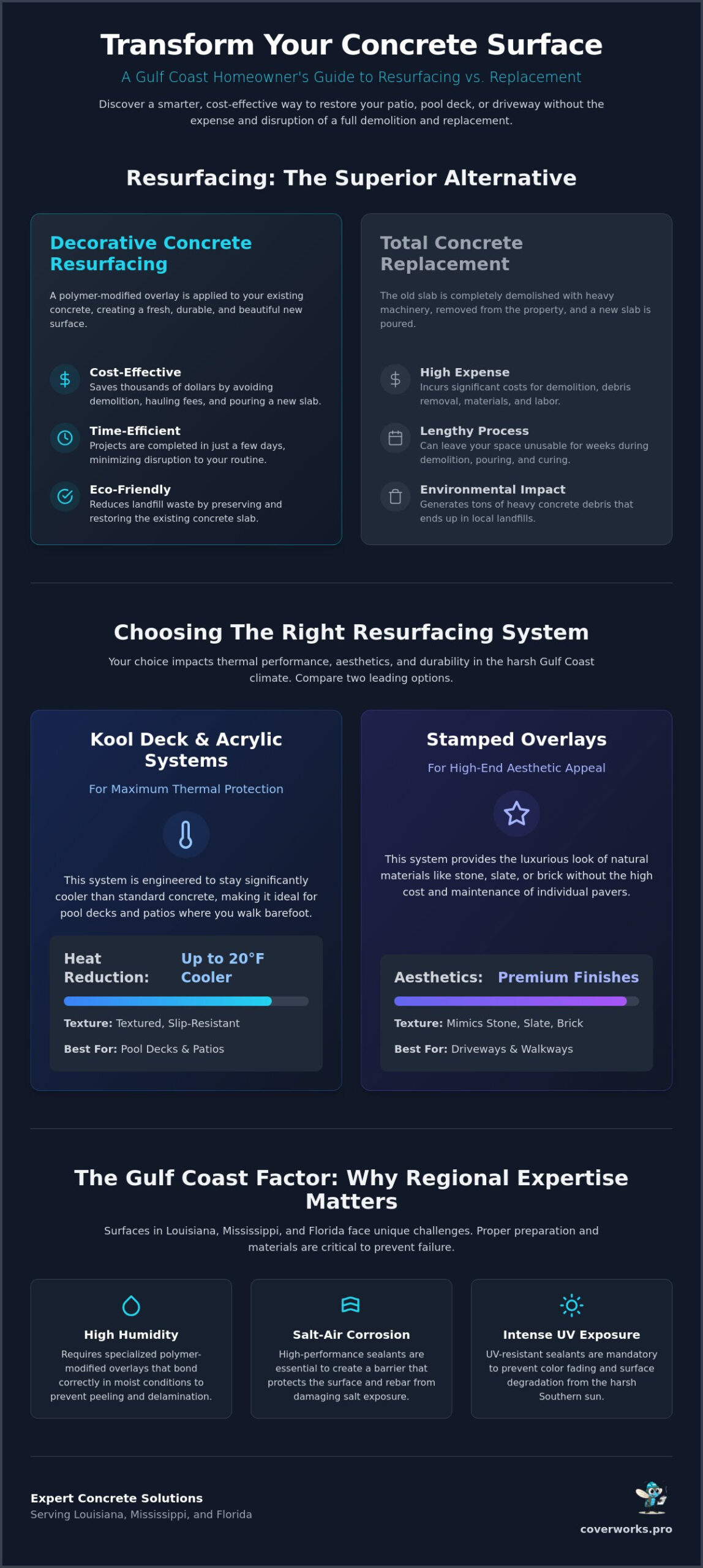
    Homeowners across the Gulf Coast often assume that a cracked or stained driveway requires a jackhammer and a fleet of dump trucks. This common misconception leads to unnecessary expenses and weeks of property disruption. Choosing professional decorative concrete resurfacing contractors offers a smarter path by utilizing the existing slab as a foundation. Decorative concrete resurfacing involves applying a polymer-modified overlay to your current concrete to create a fresh, durable surface.

    The financial advantage is clear. Total replacement involves demolition, hauling fees, and the high cost of pouring a full-depth slab. Restoration typically saves thousands of dollars because you aren’t paying for the removal of tons of old material. Beyond the budget, time is a major factor. While a full replacement can leave your pool deck or driveway out of commission for weeks during the curing process, most resurfacing projects are completed in just a few days. This efficiency reduces the impact on your daily routine and ensures your outdoor space is ready for use much faster.

    Preserving the existing base is also a win for the environment. By opting for decorative concrete techniques, you keep heavy debris out of local landfills. It’s a sustainable approach that prioritizes structural longevity over wasteful disposal.

    The Science of Concrete Restoration

    Modern resurfacing isn’t just a thin layer of paint; it’s a sophisticated chemical bond. Polymer-modified overlays are engineered to adhere at a molecular level to the original slab, creating a unified structure. These materials are designed with high compressive strength to ensure they can handle vehicle traffic and the intense thermal expansion common in New Orleans and Gulfport. An overlay is a high-strength cementitious topping used for rejuvenation. This chemical integration prevents the new surface from peeling or flaking under the heavy pressure of the Southern sun.

    When Resurfacing is the Right Choice

    Not every slab is a candidate for restoration, so a professional evaluation is vital. Resurfacing is the ideal solution for surfaces suffering from spalling, minor hairline cracks, or deep-set stains that pressure washing can’t reach. Expert decorative concrete resurfacing contractors will first identify the difference between cosmetic cracks and structural failures. If the slab is sinking or has wide, deep fissures indicating a compromised base, replacement might be necessary. However, for most aging patios, resurfacing adds a vital layer of UV and moisture protection that stops further degradation in its tracks.

    Comparing Systems: Kool Deck vs. Stamped Overlays

    Selecting the right resurfacing system is about more than just picking a color. It’s a technical decision that impacts how your surface performs in the July heat of Biloxi or the intense humidity of New Orleans. Professional decorative concrete resurfacing contractors typically categorize systems based on their primary function: thermal protection, aesthetic mimicry, or high-traffic durability. Understanding these differences ensures your investment survives the harsh Gulf Coast environment while meeting your specific lifestyle needs. Use the comparison below to identify which system aligns with your project goals.

    Feature Kool Deck Stamped Overlays
    Primary Benefit Maximum Thermal Protection High-End Aesthetic Appeal
    Texture Knock-down / Lace Finish Patterned (Stone, Slate, Brick)
    Heat Management Reduces surface temp by up to 20 degrees Standard thermal properties
    Maintenance Low (Requires periodic sealing) Minimal (No grout lines to weed)

    Acrylic finishes and high-performance sealants serve as the final line of defense for any decorative project. These finishes offer vibrant color options and vital slip-resistance for wet areas. However, the sealant is what truly preserves the work. According to the American Society of Concrete Contractors, proper sealing is essential to protect decorative finishes from UV degradation and moisture intrusion. A quality sealant acts as a barrier against salt-air corrosion, which is a constant threat for properties near the Mississippi and Alabama coastlines. If you’re ready to upgrade, exploring professional concrete resurfacing options can help you determine the best fit for your home’s layout.

    Kool Deck: The Ultimate Solution for Southern Heat

    Kool Deck remains the industry standard for thermal protection on pool decks. It’s specifically engineered to lower surface temperatures by up to 20 degrees compared to standard concrete. This temperature drop is a must-have for families in Alabama and Mississippi who want to walk comfortably on their patios without footwear. Because it’s a breathable, cementitious product, it handles the expansion and contraction of the Southern climate without delaminating. Before starting your project, review our Kool Deck resurfacing checklist for slip-resistant pool deck coatings to ensure every step is covered. For more detailed tips on managing heat, see our guide on How to Cool Patio Deck Surfaces: A Gulf Coast Homeowner’s Guide.

    Stamped and Textured Finishes for Aesthetic Appeal

    Stamped overlays allow homeowners to achieve a high-end look without the maintenance headache of natural materials. These systems replicate the appearance of slate, brick, or natural stone by imprinting patterns into a polymer-modified base. Unlike traditional pavers, stamped overlays don’t have grout lines where weeds can grow or dirt can collect. This creates a seamless, durable surface that is easy to clean. Decorative concrete resurfacing contractors can customize these patterns to match your home’s specific architectural style while adding slip-resistant textures that keep wet pool environments safe for everyone. To explore the full range of options available for your outdoor space, our guide to the 5 best decorative concrete patio finishes for Gulf Coast homes covers each system in detail so you can choose the right fit for your climate and lifestyle.

    The Gulf Coast Factor: Why Regional Expertise Matters

    Success in resurfacing depends entirely on how the material interacts with local environmental conditions. In New Orleans and Slidell, the combination of high water tables and extreme humidity creates a unique set of challenges that national franchises often overlook. Experienced decorative concrete resurfacing contractors understand that a product which works in the dry heat of Arizona will likely fail in the damp heat of Louisiana. We focus on the chemistry of the bond to ensure it survives our local climate without bubbling or peeling.

    One of the most significant hurdles is the “humidity trap.” If moisture from the ground is trapped under a non-breathable coating, the resulting vapor pressure will eventually blow the overlay right off the slab. The American Concrete Institute provides rigorous standards for moisture vapor emission rates that must be tested before application. Following these industry standards is the difference between a surface that lasts decades and one that fails after the first hurricane season. Our team uses these benchmarks to verify that the substrate is ready for a permanent bond.

    Thermal expansion also plays a major role in the longevity of your project. Southern temperature swings cause concrete to move more than you might realize. Without proper joint placement and flexible polymer additives, the resurfaced layer will crack as the original slab expands and contracts. Local contractors also prioritize building code compliance, particularly regarding wind loads and drainage requirements in the Florida panhandle and coastal Louisiana. Adhering to these local regulations isn’t just about passing an inspection; it’s about structural safety for your family.

    Combating High Humidity and Heavy Rainfall

    In communities like Metairie where heavy rainfall is a weekly occurrence, surface preparation is the most critical phase. While “off-the-shelf” DIY kits suggest a simple pressure wash, professional decorative concrete resurfacing contractors use mechanical grinding or shot-blasting to open the concrete’s pores. This ensures a mechanical bond that can withstand heavy rainfall and high moisture levels. We utilize breathable coatings and specialized vapor barriers that allow the slab to exhale moisture without compromising the finish or the structural integrity of the overlay.

    Saltwater Protection for Coastal Properties

    If your property is in Biloxi or Gulfport, salt-air corrosion is a constant threat to your outdoor spaces. Salt crystals can penetrate standard porous concrete, causing the internal rebar to rust and the surface to flake away. We employ advanced sealing techniques that create a non-porous shield against these corrosive elements. Coastal concrete requires specialized non-porous finishes to prevent salt-air intrusion from destroying the underlying structural integrity of the slab. This proactive approach preserves the beauty of your deck while preventing the long-term decay typical of coastal properties. Homeowners in the region who want to maximize their outdoor living investment should also consider pairing their resurfaced deck with custom aluminum patio covers Mississippi homeowners rely on to shield their surfaces from the sun and storm damage year-round.

    Expert Decorative Concrete Resurfacing Contractors for Gulf Coast Homes

    How to Evaluate Decorative Concrete Resurfacing Contractors

    Evaluating decorative concrete resurfacing contractors requires looking beyond the price tag. You’re entrusting a professional with the structural and aesthetic integrity of your property. Start by verifying their specific experience with polymer-modified systems and Kool Deck. A general concrete finisher might not understand the delicate chemistry required for overlays to bond in high-humidity environments like Metairie or Biloxi. It’s vital to choose a team that treats the project as a technical installation rather than a simple cosmetic patch.

    Demand to see a portfolio of local projects that have survived at least three summers. This is the ultimate test for any resurfacing job in the South. If a finish can’t handle three years of intense UV exposure and tropical rain, it won’t last a decade. You should also ensure they hold current local licensing and insurance for Louisiana, Mississippi, or Alabama. A licensed contractor respects the building codes that protect your home’s value and safety.

    Surface preparation is the most overlooked phase of the project. Ask if they use mechanical grinding or just a pressure washer. Pressure washing often leaves a “laitance” layer that prevents the overlay from bonding properly. Professional decorative concrete resurfacing contractors use industrial grinders to open the pores of the slab. This mechanical prep ensures the new material becomes a permanent part of the foundation rather than a thin layer sitting on top.

    Critical Questions for Your Estimate

    Don’t settle for a vague quote. Get specific answers to these technical questions to gauge a contractor’s expertise:

    • How do you handle existing cracks to prevent them from returning through the new surface?
    • What is your process for ensuring a chemical bond between the old slab and the new overlay?
    • Do you provide a written warranty against delamination or peeling?

    A reliable guide will explain these steps clearly. They’ll focus on the structural durability of the finish rather than just the final color choice.

    The Importance of Proper Engineering and Permitting

    Resurfacing often happens near existing structures like pool enclosures or patio covers. A contractor must understand how their work affects the structural attachment of these aluminum enclosures. In the Florida panhandle and coastal Mississippi, wind load requirements are strict. Your resurfacing project must not compromise the engineering of the enclosure’s base or the integrity of the anchor bolts. This level of technical oversight is similar to what you should expect when hiring the best screen room contractors in Alabama. Proper permitting ensures that every aspect of the job meets local safety standards.

    Transforming Your Outdoor Living Space with CoverWorks Inc.

    Choosing the right decorative concrete resurfacing contractors is the final step in reclaiming your backyard from the heat and humidity. At CoverWorks Inc., we bring over 20 years of regional experience to every project. Our legacy is built on a deep understanding of Gulf Coast engineering and a commitment to structural integrity. We don’t just apply a cosmetic coating; we ensure your surface is prepared to withstand the specific wind loads and humidity levels of the Deep South. This Master Craftsman approach ensures that your renovation is as durable as it is beautiful.

    The “CoverWorks Advantage” lies in our ability to coordinate complex outdoor projects seamlessly. Many contractors only handle the concrete, leaving you to find someone else for your screen enclosure or patio cover repairs. We specialize in both. By managing the deck resurfacing and aluminum structural repairs simultaneously, we ensure that every attachment point is secure and every seal is watertight. This integrated method prevents the logistical headaches of juggling multiple crews and ensures a cohesive look for your entire outdoor living area.

    • 20+ years of field experience in Louisiana and Mississippi.
    • Expert coordination of concrete work and aluminum structural repairs.
    • Strict adherence to local building codes and wind load requirements.
    • Fast installations with a focus on minimizing property disruption.

    A Seamless Renovation Process

    Our team prioritizes efficiency without ever compromising on safety or quality. We handle the entire scope of work, from mechanical concrete preparation to final rescreening services. This comprehensive management minimizes downtime, allowing you to get back to enjoying your pool faster. If you’re considering a full upgrade, you might find our Cost of Pool Enclosure in Louisiana: 2026 Price & Buying Guide helpful for planning your budget and design. We ensure that your new surface and structure work together perfectly to enhance your property’s value.

    Get Your Free Estimate Today

    We’re proud to serve homeowners across New Orleans, Metairie, Slidell, and Gulfport with reliable, professional service. When you schedule an on-site consultation, we perform a detailed evaluation of your existing slab to check for moisture issues and structural cracks. You’ll receive a same-day quote that outlines the best resurfacing system for your specific environment. We believe in providing clear, technical information so you can make an informed decision for your home. Our goal is to provide a stress-free experience that results in a beautiful, long-lasting outdoor space.

    Elevate Your Home with a Durable Outdoor Transformation

    Your outdoor space is an extension of your lifestyle; it shouldn’t be sidelined by cracked slabs or scorching surface temperatures. Choosing to restore rather than replace your concrete saves time and thousands of dollars while providing a superior thermal barrier. We’ve seen how the Gulf Coast climate tests every material, which is why we prioritize mechanical preparation and breathable, high-performance overlays. This Master Craftsman approach ensures your investment survives the humidity and salt air typical of our region.

    Partnering with specialized decorative concrete resurfacing contractors ensures that your new finish isn’t just beautiful but structurally sound. At CoverWorks Inc., we bring 20+ years of regional experience to every project, offering a unique expertise in both aluminum structures and concrete surfaces. Our team is ready to provide same-day quotes to help you move from a functional need to a vision of improved comfort and style.

    Take the first step toward a cooler, safer, and more attractive patio. We look forward to helping you build a space that stands up to the elements and provides lasting value for your home.

    Frequently Asked Questions

    How long does decorative concrete resurfacing typically last?

    A professionally installed resurfacing system can last 10 to 15 years or longer with proper maintenance. The lifespan depends heavily on the quality of the mechanical bond and the regular application of a high-quality sealer. We recommend resealing your surface every three to five years to protect the pigments from the intense UV rays found in New Orleans and Biloxi.

    Can you resurface concrete that has large cracks or is sinking?

    Resurfacing is designed for structurally sound slabs with cosmetic or surface-level damage. It is not a fix for foundation failure or sinking concrete. While decorative concrete resurfacing contractors can repair minor hairline cracks using epoxy injectors, large moving cracks will eventually telegraph through the new overlay. Sinking slabs usually require mudjacking or soil stabilization before a new finish can be applied.

    Is Kool Deck the same as stamped concrete?

    No, these are different systems with distinct functions. Kool Deck is a specialized cementitious topping engineered specifically for heat reduction on pool decks. Stamped concrete is a decorative technique where patterns are imprinted into a thicker overlay to mimic stone or brick. While stamped finishes offer high aesthetic value, Kool Deck is the superior choice for keeping surfaces cool enough for bare feet in the Mississippi summer. To learn more about what goes into a professional Kool Deck resurfacing pool deck project, our detailed checklist walks you through every step of the process.

    How soon can I walk on my new pool deck after resurfacing?

    You can typically walk on the surface in light footwear 24 to 48 hours after the final sealer is applied. It is vital to wait at least 72 hours before moving heavy patio furniture, planters, or grills back into place. The chemicals in the overlay continue to cure for up to 28 days; avoiding heavy impact during the first week ensures the finish achieves its full rated strength.

    Does resurfacing concrete help with slip resistance?

    Yes, resurfacing is an excellent way to improve traction in wet areas. Most systems utilize a textured finish, such as a knock-down or broom texture, which provides natural grip. Decorative concrete resurfacing contractors can also mix specialized slip-resistant aggregates into the final sealer. This creates a safer environment for families in splash zones without compromising the visual appeal of the project.

    Will the color of my resurfaced patio fade in the Gulf Coast sun?

    High-quality resurfacing systems use UV-stable pigments that are designed to resist fading even under direct Southern sunlight. While some minor weathering is expected over a decade, professional-grade sealers act as a protective barrier against pigment degradation. Choosing lighter, earth-toned colors further helps maintain the look while also contributing to a cooler surface temperature. For a deeper look at which decorative concrete patio finishes hold up best against Gulf Coast UV exposure and humidity, our comprehensive comparison guide breaks down the top options for Southern homeowners.

    Do I need to move my pool enclosure to resurface the deck?

    You do not need to remove the entire structure to complete the work. Our team carefully masks the aluminum tracks and works around the base plates to ensure a clean finish. Because we specialize in both enclosures and concrete, we check the structural anchors during the process. This ensures your enclosure remains secure and the new deck height does not interfere with the door hardware or drainage.