Tag: Gulf Coast Home Improvement

  • Expert Decorative Concrete Resurfacing Contractors for Gulf Coast Homes

    Expert Decorative Concrete Resurfacing Contractors for Gulf Coast Homes

    Your backyard patio should be a sanctuary, not a surface that burns your feet through your shoes by mid-afternoon. Many homeowners in New Orleans and across the Gulf Coast find that their outdoor spaces become unusable as the temperature rises and humidity sets in. You probably agree that staring at ugly cracks and stubborn stains is frustrating, especially when you’re trying to maintain your property’s value. Working with professional decorative concrete resurfacing contractors allows you to fix these issues without the massive expense and mess of a full slab replacement.

    You’ll discover how to restore your worn concrete using specialized techniques designed to withstand the unique challenges of the Southern climate. Whether you’re in Biloxi, Slidell, or Gulfport, the goal is a beautiful, slip-resistant finish that stays cool under the sun and handles heavy rain. We’ll explore the differences between various coating systems like Kool Deck and acrylics while highlighting the importance of proper structural preparation. This guide provides the technical clarity you need to choose a durable solution that keeps your home safe and stylish for years to come.

    Key Takeaways

    • Learn how polymer-modified overlays restore structural integrity and aesthetics at a fraction of the cost of full concrete demolition.
    • Compare high-performance systems like Kool Deck for heat reduction against stamped overlays that replicate the look of natural stone or slate.
    • Understand why regional expertise is critical for managing the Gulf Coast’s humidity and salt-air corrosion to prevent surface delamination.
    • Discover the essential criteria for selecting decorative concrete resurfacing contractors, including the importance of mechanical surface preparation over simple pressure washing.
    • See how coordinating your deck resurfacing with pool enclosure maintenance ensures a seamless and durable outdoor transformation.

    Why Hire Decorative Concrete Resurfacing Contractors vs. Total Replacement?

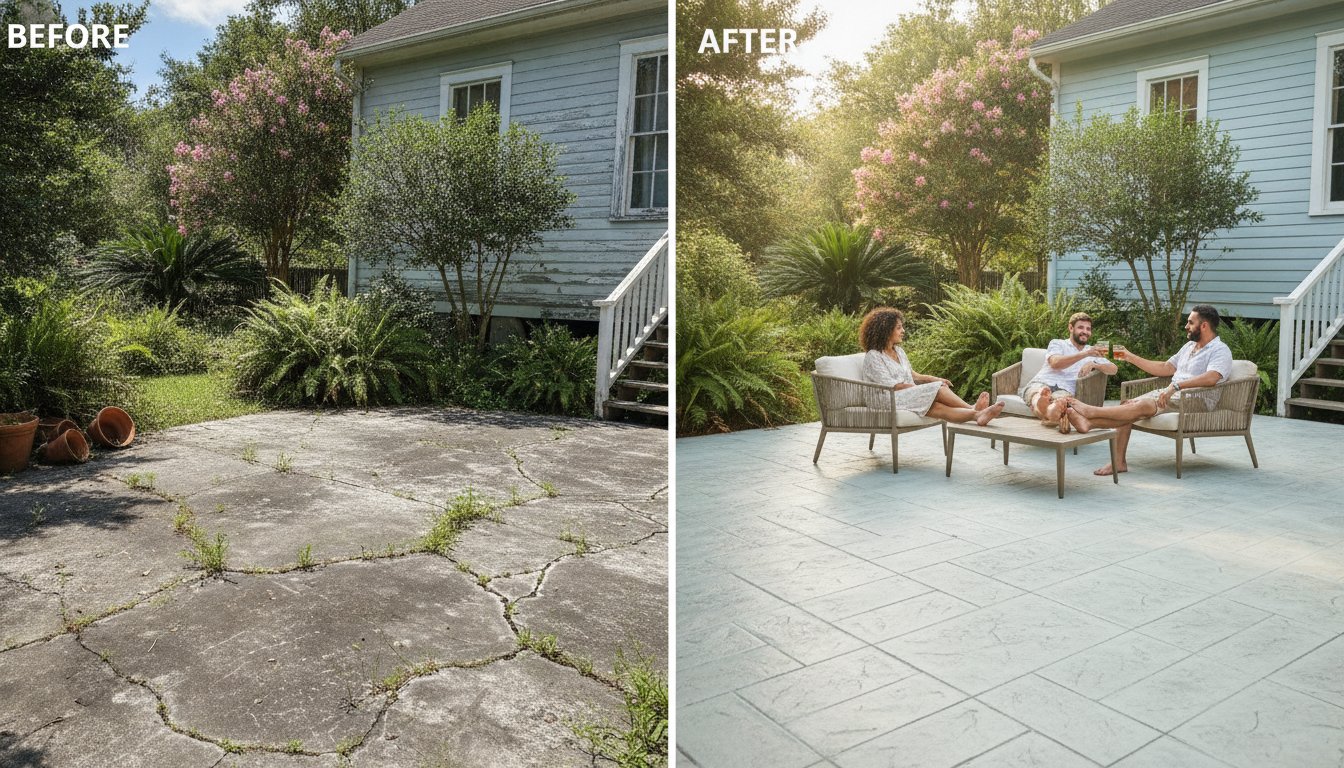
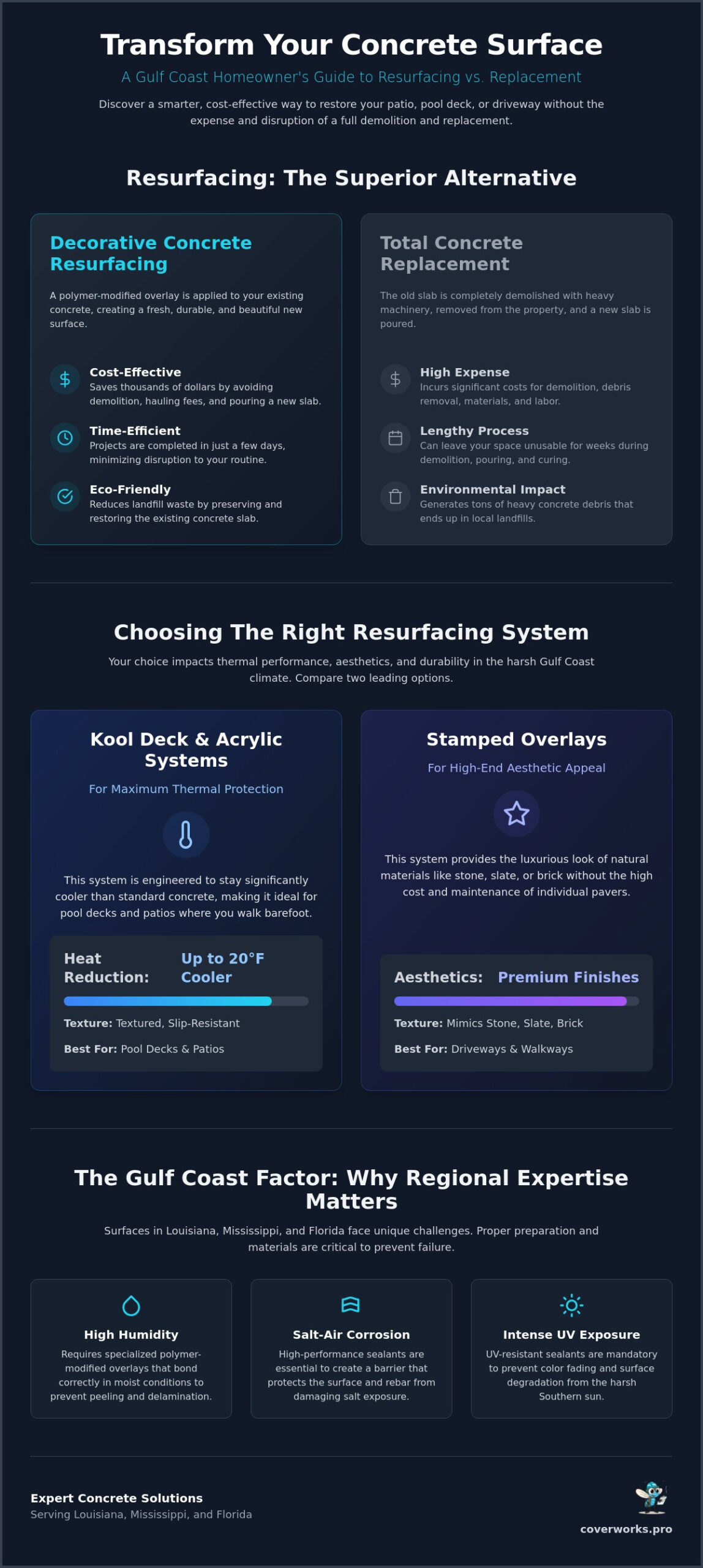
    Homeowners across the Gulf Coast often assume that a cracked or stained driveway requires a jackhammer and a fleet of dump trucks. This common misconception leads to unnecessary expenses and weeks of property disruption. Choosing professional decorative concrete resurfacing contractors offers a smarter path by utilizing the existing slab as a foundation. Decorative concrete resurfacing involves applying a polymer-modified overlay to your current concrete to create a fresh, durable surface.

    The financial advantage is clear. Total replacement involves demolition, hauling fees, and the high cost of pouring a full-depth slab. Restoration typically saves thousands of dollars because you aren’t paying for the removal of tons of old material. Beyond the budget, time is a major factor. While a full replacement can leave your pool deck or driveway out of commission for weeks during the curing process, most resurfacing projects are completed in just a few days. This efficiency reduces the impact on your daily routine and ensures your outdoor space is ready for use much faster.

    Preserving the existing base is also a win for the environment. By opting for decorative concrete techniques, you keep heavy debris out of local landfills. It’s a sustainable approach that prioritizes structural longevity over wasteful disposal.

    The Science of Concrete Restoration

    Modern resurfacing isn’t just a thin layer of paint; it’s a sophisticated chemical bond. Polymer-modified overlays are engineered to adhere at a molecular level to the original slab, creating a unified structure. These materials are designed with high compressive strength to ensure they can handle vehicle traffic and the intense thermal expansion common in New Orleans and Gulfport. An overlay is a high-strength cementitious topping used for rejuvenation. This chemical integration prevents the new surface from peeling or flaking under the heavy pressure of the Southern sun.

    When Resurfacing is the Right Choice

    Not every slab is a candidate for restoration, so a professional evaluation is vital. Resurfacing is the ideal solution for surfaces suffering from spalling, minor hairline cracks, or deep-set stains that pressure washing can’t reach. Expert decorative concrete resurfacing contractors will first identify the difference between cosmetic cracks and structural failures. If the slab is sinking or has wide, deep fissures indicating a compromised base, replacement might be necessary. However, for most aging patios, resurfacing adds a vital layer of UV and moisture protection that stops further degradation in its tracks.

    Comparing Systems: Kool Deck vs. Stamped Overlays

    Selecting the right resurfacing system is about more than just picking a color. It’s a technical decision that impacts how your surface performs in the July heat of Biloxi or the intense humidity of New Orleans. Professional decorative concrete resurfacing contractors typically categorize systems based on their primary function: thermal protection, aesthetic mimicry, or high-traffic durability. Understanding these differences ensures your investment survives the harsh Gulf Coast environment while meeting your specific lifestyle needs. Use the comparison below to identify which system aligns with your project goals.

    Feature Kool Deck Stamped Overlays
    Primary Benefit Maximum Thermal Protection High-End Aesthetic Appeal
    Texture Knock-down / Lace Finish Patterned (Stone, Slate, Brick)
    Heat Management Reduces surface temp by up to 20 degrees Standard thermal properties
    Maintenance Low (Requires periodic sealing) Minimal (No grout lines to weed)

    Acrylic finishes and high-performance sealants serve as the final line of defense for any decorative project. These finishes offer vibrant color options and vital slip-resistance for wet areas. However, the sealant is what truly preserves the work. According to the American Society of Concrete Contractors, proper sealing is essential to protect decorative finishes from UV degradation and moisture intrusion. A quality sealant acts as a barrier against salt-air corrosion, which is a constant threat for properties near the Mississippi and Alabama coastlines. If you’re ready to upgrade, exploring professional concrete resurfacing options can help you determine the best fit for your home’s layout.

    Kool Deck: The Ultimate Solution for Southern Heat

    Kool Deck remains the industry standard for thermal protection on pool decks. It’s specifically engineered to lower surface temperatures by up to 20 degrees compared to standard concrete. This temperature drop is a must-have for families in Alabama and Mississippi who want to walk comfortably on their patios without footwear. Because it’s a breathable, cementitious product, it handles the expansion and contraction of the Southern climate without delaminating. Before starting your project, review our Kool Deck resurfacing checklist for slip-resistant pool deck coatings to ensure every step is covered. For more detailed tips on managing heat, see our guide on How to Cool Patio Deck Surfaces: A Gulf Coast Homeowner’s Guide.

    Stamped and Textured Finishes for Aesthetic Appeal

    Stamped overlays allow homeowners to achieve a high-end look without the maintenance headache of natural materials. These systems replicate the appearance of slate, brick, or natural stone by imprinting patterns into a polymer-modified base. Unlike traditional pavers, stamped overlays don’t have grout lines where weeds can grow or dirt can collect. This creates a seamless, durable surface that is easy to clean. Decorative concrete resurfacing contractors can customize these patterns to match your home’s specific architectural style while adding slip-resistant textures that keep wet pool environments safe for everyone. To explore the full range of options available for your outdoor space, our guide to the 5 best decorative concrete patio finishes for Gulf Coast homes covers each system in detail so you can choose the right fit for your climate and lifestyle.

    The Gulf Coast Factor: Why Regional Expertise Matters

    Success in resurfacing depends entirely on how the material interacts with local environmental conditions. In New Orleans and Slidell, the combination of high water tables and extreme humidity creates a unique set of challenges that national franchises often overlook. Experienced decorative concrete resurfacing contractors understand that a product which works in the dry heat of Arizona will likely fail in the damp heat of Louisiana. We focus on the chemistry of the bond to ensure it survives our local climate without bubbling or peeling.

    One of the most significant hurdles is the “humidity trap.” If moisture from the ground is trapped under a non-breathable coating, the resulting vapor pressure will eventually blow the overlay right off the slab. The American Concrete Institute provides rigorous standards for moisture vapor emission rates that must be tested before application. Following these industry standards is the difference between a surface that lasts decades and one that fails after the first hurricane season. Our team uses these benchmarks to verify that the substrate is ready for a permanent bond.

    Thermal expansion also plays a major role in the longevity of your project. Southern temperature swings cause concrete to move more than you might realize. Without proper joint placement and flexible polymer additives, the resurfaced layer will crack as the original slab expands and contracts. Local contractors also prioritize building code compliance, particularly regarding wind loads and drainage requirements in the Florida panhandle and coastal Louisiana. Adhering to these local regulations isn’t just about passing an inspection; it’s about structural safety for your family.

    Combating High Humidity and Heavy Rainfall

    In communities like Metairie where heavy rainfall is a weekly occurrence, surface preparation is the most critical phase. While “off-the-shelf” DIY kits suggest a simple pressure wash, professional decorative concrete resurfacing contractors use mechanical grinding or shot-blasting to open the concrete’s pores. This ensures a mechanical bond that can withstand heavy rainfall and high moisture levels. We utilize breathable coatings and specialized vapor barriers that allow the slab to exhale moisture without compromising the finish or the structural integrity of the overlay.

    Saltwater Protection for Coastal Properties

    If your property is in Biloxi or Gulfport, salt-air corrosion is a constant threat to your outdoor spaces. Salt crystals can penetrate standard porous concrete, causing the internal rebar to rust and the surface to flake away. We employ advanced sealing techniques that create a non-porous shield against these corrosive elements. Coastal concrete requires specialized non-porous finishes to prevent salt-air intrusion from destroying the underlying structural integrity of the slab. This proactive approach preserves the beauty of your deck while preventing the long-term decay typical of coastal properties. Homeowners in the region who want to maximize their outdoor living investment should also consider pairing their resurfaced deck with custom aluminum patio covers Mississippi homeowners rely on to shield their surfaces from the sun and storm damage year-round.
    Expert Decorative Concrete Resurfacing Contractors for Gulf Coast Homes

    How to Evaluate Decorative Concrete Resurfacing Contractors

    Evaluating decorative concrete resurfacing contractors requires looking beyond the price tag. You’re entrusting a professional with the structural and aesthetic integrity of your property. Start by verifying their specific experience with polymer-modified systems and Kool Deck. A general concrete finisher might not understand the delicate chemistry required for overlays to bond in high-humidity environments like Metairie or Biloxi. It’s vital to choose a team that treats the project as a technical installation rather than a simple cosmetic patch.

    Demand to see a portfolio of local projects that have survived at least three summers. This is the ultimate test for any resurfacing job in the South. If a finish can’t handle three years of intense UV exposure and tropical rain, it won’t last a decade. You should also ensure they hold current local licensing and insurance for Louisiana, Mississippi, or Alabama. A licensed contractor respects the building codes that protect your home’s value and safety.

    Surface preparation is the most overlooked phase of the project. Ask if they use mechanical grinding or just a pressure washer. Pressure washing often leaves a “laitance” layer that prevents the overlay from bonding properly. Professional decorative concrete resurfacing contractors use industrial grinders to open the pores of the slab. This mechanical prep ensures the new material becomes a permanent part of the foundation rather than a thin layer sitting on top.

    Critical Questions for Your Estimate

    Don’t settle for a vague quote. Get specific answers to these technical questions to gauge a contractor’s expertise:

    • How do you handle existing cracks to prevent them from returning through the new surface?
    • What is your process for ensuring a chemical bond between the old slab and the new overlay?
    • Do you provide a written warranty against delamination or peeling?

    A reliable guide will explain these steps clearly. They’ll focus on the structural durability of the finish rather than just the final color choice.

    The Importance of Proper Engineering and Permitting

    Resurfacing often happens near existing structures like pool enclosures or patio covers. A contractor must understand how their work affects the structural attachment of these aluminum enclosures. In the Florida panhandle and coastal Mississippi, wind load requirements are strict. Your resurfacing project must not compromise the engineering of the enclosure’s base or the integrity of the anchor bolts. This level of technical oversight is similar to what you should expect when hiring the best screen room contractors in Alabama. Proper permitting ensures that every aspect of the job meets local safety standards.

    Transforming Your Outdoor Living Space with CoverWorks Inc.

    Choosing the right decorative concrete resurfacing contractors is the final step in reclaiming your backyard from the heat and humidity. At CoverWorks Inc., we bring over 20 years of regional experience to every project. Our legacy is built on a deep understanding of Gulf Coast engineering and a commitment to structural integrity. We don’t just apply a cosmetic coating; we ensure your surface is prepared to withstand the specific wind loads and humidity levels of the Deep South. This Master Craftsman approach ensures that your renovation is as durable as it is beautiful.

    The “CoverWorks Advantage” lies in our ability to coordinate complex outdoor projects seamlessly. Many contractors only handle the concrete, leaving you to find someone else for your screen enclosure or patio cover repairs. We specialize in both. By managing the deck resurfacing and aluminum structural repairs simultaneously, we ensure that every attachment point is secure and every seal is watertight. This integrated method prevents the logistical headaches of juggling multiple crews and ensures a cohesive look for your entire outdoor living area.

    • 20+ years of field experience in Louisiana and Mississippi.
    • Expert coordination of concrete work and aluminum structural repairs.
    • Strict adherence to local building codes and wind load requirements.
    • Fast installations with a focus on minimizing property disruption.

    A Seamless Renovation Process

    Our team prioritizes efficiency without ever compromising on safety or quality. We handle the entire scope of work, from mechanical concrete preparation to final rescreening services. This comprehensive management minimizes downtime, allowing you to get back to enjoying your pool faster. If you’re considering a full upgrade, you might find our Cost of Pool Enclosure in Louisiana: 2026 Price & Buying Guide helpful for planning your budget and design. We ensure that your new surface and structure work together perfectly to enhance your property’s value.

    Get Your Free Estimate Today

    We’re proud to serve homeowners across New Orleans, Metairie, Slidell, and Gulfport with reliable, professional service. When you schedule an on-site consultation, we perform a detailed evaluation of your existing slab to check for moisture issues and structural cracks. You’ll receive a same-day quote that outlines the best resurfacing system for your specific environment. We believe in providing clear, technical information so you can make an informed decision for your home. Our goal is to provide a stress-free experience that results in a beautiful, long-lasting outdoor space.

    Elevate Your Home with a Durable Outdoor Transformation

    Your outdoor space is an extension of your lifestyle; it shouldn’t be sidelined by cracked slabs or scorching surface temperatures. Choosing to restore rather than replace your concrete saves time and thousands of dollars while providing a superior thermal barrier. We’ve seen how the Gulf Coast climate tests every material, which is why we prioritize mechanical preparation and breathable, high-performance overlays. This Master Craftsman approach ensures your investment survives the humidity and salt air typical of our region.

    Partnering with specialized decorative concrete resurfacing contractors ensures that your new finish isn’t just beautiful but structurally sound. At CoverWorks Inc., we bring 20+ years of regional experience to every project, offering a unique expertise in both aluminum structures and concrete surfaces. Our team is ready to provide same-day quotes to help you move from a functional need to a vision of improved comfort and style.

    Take the first step toward a cooler, safer, and more attractive patio. We look forward to helping you build a space that stands up to the elements and provides lasting value for your home.

    Frequently Asked Questions

    How long does decorative concrete resurfacing typically last?

    A professionally installed resurfacing system can last 10 to 15 years or longer with proper maintenance. The lifespan depends heavily on the quality of the mechanical bond and the regular application of a high-quality sealer. We recommend resealing your surface every three to five years to protect the pigments from the intense UV rays found in New Orleans and Biloxi.

    Can you resurface concrete that has large cracks or is sinking?

    Resurfacing is designed for structurally sound slabs with cosmetic or surface-level damage. It is not a fix for foundation failure or sinking concrete. While decorative concrete resurfacing contractors can repair minor hairline cracks using epoxy injectors, large moving cracks will eventually telegraph through the new overlay. Sinking slabs usually require mudjacking or soil stabilization before a new finish can be applied.

    Is Kool Deck the same as stamped concrete?

    No, these are different systems with distinct functions. Kool Deck is a specialized cementitious topping engineered specifically for heat reduction on pool decks. Stamped concrete is a decorative technique where patterns are imprinted into a thicker overlay to mimic stone or brick. While stamped finishes offer high aesthetic value, Kool Deck is the superior choice for keeping surfaces cool enough for bare feet in the Mississippi summer. To learn more about what goes into a professional Kool Deck resurfacing pool deck project, our detailed checklist walks you through every step of the process.

    How soon can I walk on my new pool deck after resurfacing?

    You can typically walk on the surface in light footwear 24 to 48 hours after the final sealer is applied. It is vital to wait at least 72 hours before moving heavy patio furniture, planters, or grills back into place. The chemicals in the overlay continue to cure for up to 28 days; avoiding heavy impact during the first week ensures the finish achieves its full rated strength.

    Does resurfacing concrete help with slip resistance?

    Yes, resurfacing is an excellent way to improve traction in wet areas. Most systems utilize a textured finish, such as a knock-down or broom texture, which provides natural grip. Decorative concrete resurfacing contractors can also mix specialized slip-resistant aggregates into the final sealer. This creates a safer environment for families in splash zones without compromising the visual appeal of the project.

    Will the color of my resurfaced patio fade in the Gulf Coast sun?

    High-quality resurfacing systems use UV-stable pigments that are designed to resist fading even under direct Southern sunlight. While some minor weathering is expected over a decade, professional-grade sealers act as a protective barrier against pigment degradation. Choosing lighter, earth-toned colors further helps maintain the look while also contributing to a cooler surface temperature. For a deeper look at which decorative concrete patio finishes hold up best against Gulf Coast UV exposure and humidity, our comprehensive comparison guide breaks down the top options for Southern homeowners.

    Do I need to move my pool enclosure to resurface the deck?

    You do not need to remove the entire structure to complete the work. Our team carefully masks the aluminum tracks and works around the base plates to ensure a clean finish. Because we specialize in both enclosures and concrete, we check the structural anchors during the process. This ensures your enclosure remains secure and the new deck height does not interfere with the door hardware or drainage.
  • Aluminum vs. Wood Pergola Maintenance: 2026 Comparison for Gulf Coast Homeowners

    Aluminum vs. Wood Pergola Maintenance: 2026 Comparison for Gulf Coast Homeowners

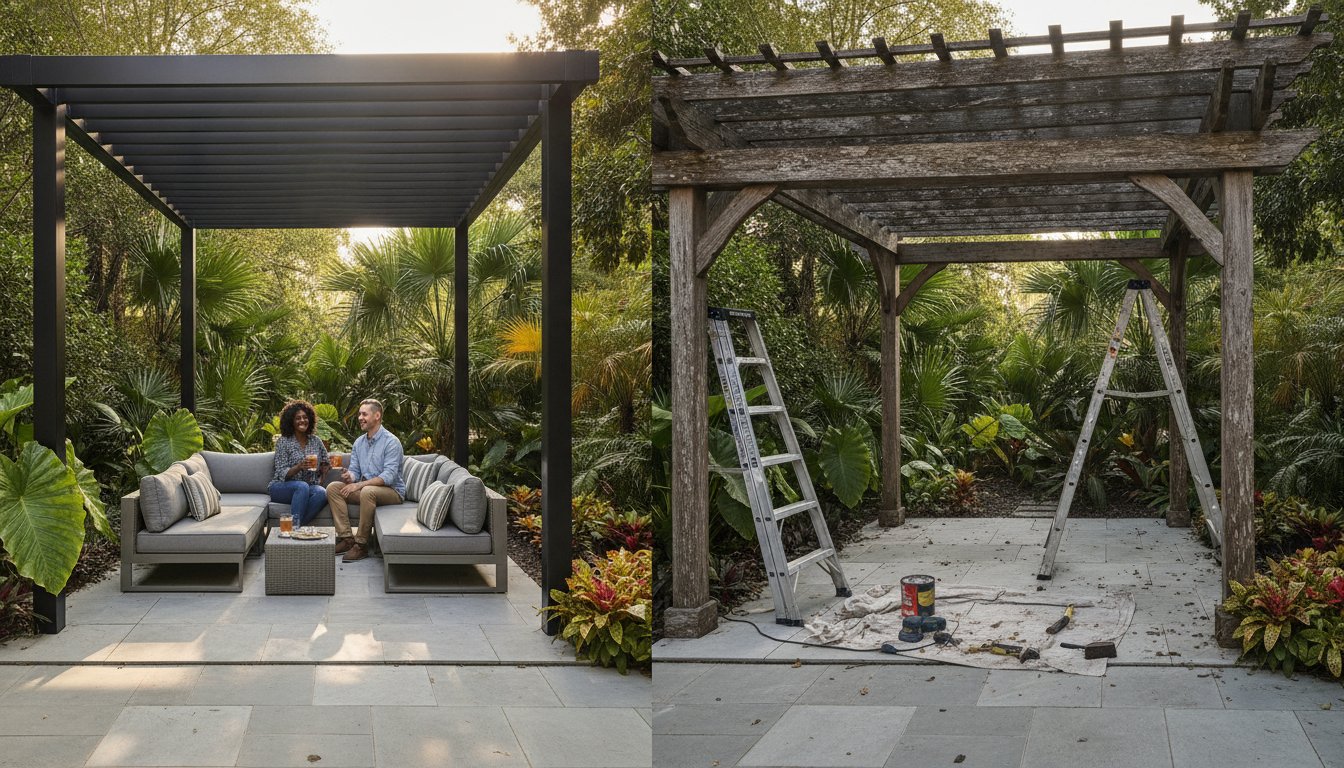
    Did you know that a wood pergola costing significantly less upfront can actually end up costing you thousands more over its lifespan due to the brutal Gulf Coast climate? While the natural look of cedar or pine is appealing, the reality of aluminum vs wood pergola maintenance often comes as a shock to homeowners in New Orleans, Gulfport, and Slidell. You shouldn’t have to choose between a beautiful backyard and your free time. We understand that you want an outdoor structure that enhances your lifestyle rather than adding to your chores list.

    This 2026 comparison reveals the hidden costs of wood rot and the increasing threat of invasive Formosan termites, which are now established in most coastal counties. You’ll discover how modern aluminum engineering meets the strict 9th Edition Florida Building Code standards and provides a 20 year solution that stands up to humidity and hurricane-force winds. We’ll examine the total cost of ownership and real-world labor requirements so you can make an informed investment for your home. By looking past the initial price tag, you can ensure your patio remains a place of relaxation instead of a source of structural worry.

    Key Takeaways

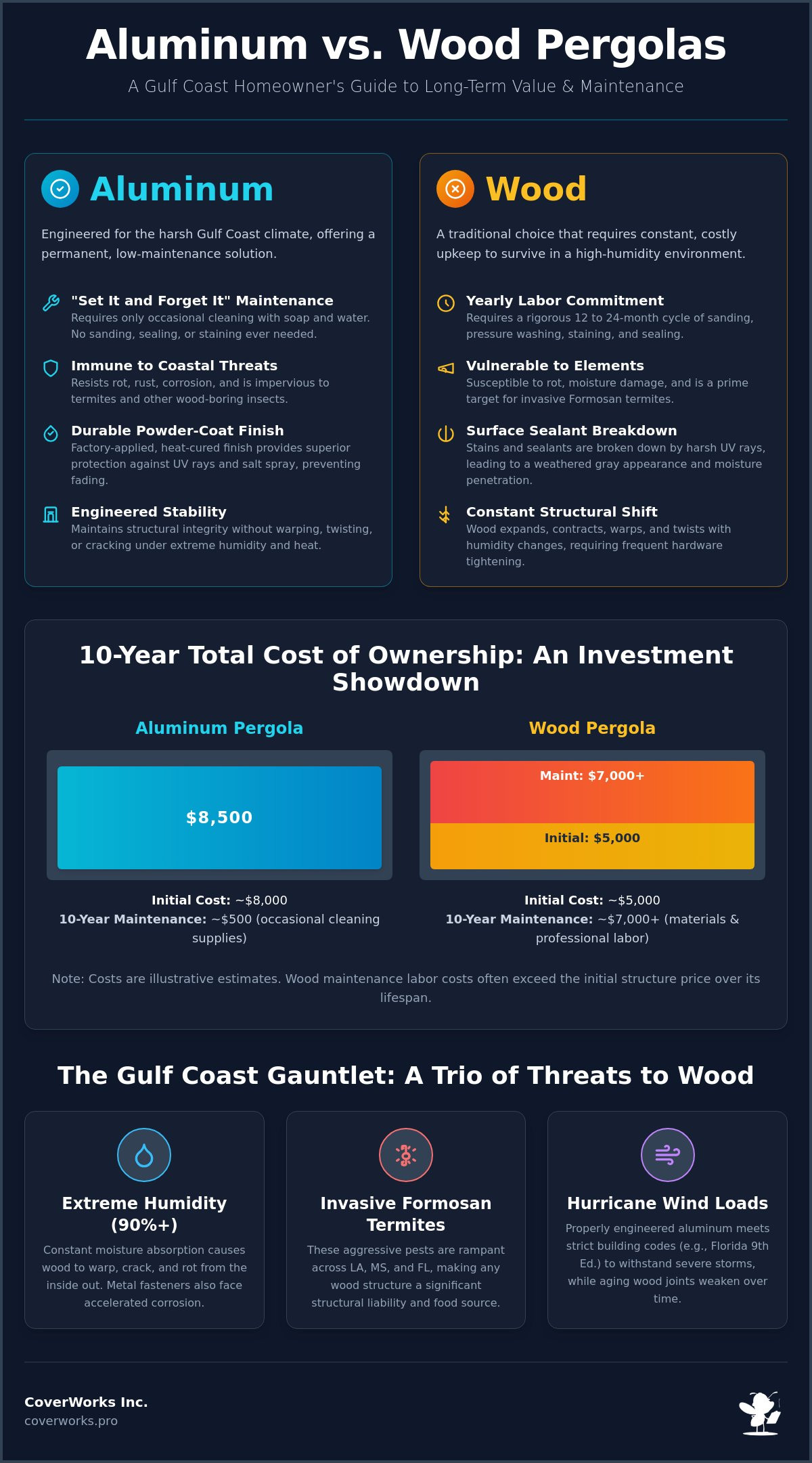
    • Understand the rigorous 12 to 24 month cycle of sanding, cleaning, and staining required to prevent wood structures from warping in 90% humidity.
    • Compare the long-term aluminum vs wood pergola maintenance requirements to see how powder-coated finishes eliminate the need for recurring chemical sealing.
    • Evaluate the true 10 year cost of ownership, where professional labor for wood upkeep often exceeds the initial investment of a premium aluminum structure.
    • Learn why the spread of invasive Formosan termites across Louisiana and Mississippi makes wood pergolas a significant structural liability for homeowners.
    • Discover how proper engineering and building code compliance ensure your shade structure is built to withstand Gulf Coast wind loads and severe storms.

    The Reality of Wood Pergola Maintenance: A Yearly Commitment

    A pergola provides an excellent architectural focal point for any backyard, but if it’s constructed from wood, that aesthetic comes with a heavy labor price. In the humid environment of the Gulf Coast, natural materials are under constant attack from moisture and heat. When homeowners weigh the pros and cons of aluminum vs wood pergola maintenance, the most immediate difference is the recurring labor cycle. Wood requires a hands-on approach every 12 to 24 months to keep it from becoming a structural liability.

    Even pressure-treated lumber isn’t immune to our local elements. While factory treatments help deter some insects, they don’t stop the wood from absorbing atmospheric moisture. High humidity in communities like Metairie and Slidell causes wood fibers to expand and contract daily. Without a fresh chemical seal, this cycle leads to warping, twisting, and deep cracks known as checking. Maintaining a wood structure involves more than just a quick rinse; it requires a deep commitment to preserving the material’s integrity.

    Sanding and Staining: The Weekend Warrior’s Burden

    The preparation process for aged wood is grueling and time-consuming. You can’t simply apply a new coat of stain over the old layer. You must power wash the structure, wait for it to dry completely, and then sand down the raised grain to ensure the new sealant adheres properly. UV rays in the South are particularly aggressive. They break down the lignin in wood faster than in northern climates, causing the fibers to turn brittle. Skipping even one year of this maintenance allows the wood to take on a permanent, weathered gray tone that’s nearly impossible to reverse without aggressive sanding.

    Structural Integrity and Rot Prevention

    Maintenance is about safety just as much as it’s about looks. Wood joints are notorious for trapping moisture, which creates a breeding ground for internal rot that often goes unnoticed until a component fails. You’ll need to inspect headers and posts regularly for soft spots. In the Gulf Coast, ground-contact rot is a major concern at the base of the structure where water pools after a heavy rain. Since wood is a dynamic material, it also shrinks as it ages. This means you’ll find yourself frequently tightening bolts and hardware to keep the structure from swaying during high-wind events.

    Hidden costs of wood maintenance include:

    • Premium oil-based stains and water-repellent sealants
    • High-quality brushes, rollers, and specialized sanding pads
    • Pressure washing equipment rentals and cleaning solutions
    • Rising professional labor fees for multi-day restoration projects

    Choosing wood means accepting a lifestyle of ongoing chores. For those in New Orleans or Biloxi who want to spend their weekends relaxing rather than scraping old finish off a beam, the labor requirements of wood can quickly overshadow its initial charm. Understanding these demands is the first step in deciding which material truly fits your long-term goals for your outdoor living space.

    Aluminum Pergola Maintenance: The ‘Set It and Forget It’ Alternative

    While wood requires a relentless cycle of sanding and staining, aluminum offers a starkly different experience. High-grade structural aluminum is engineered to endure the harsh UV rays and salt spray of the Gulf Coast without degrading. When analyzing aluminum vs wood pergola maintenance, the most significant advantage is the material’s chemical stability. Aluminum doesn’t rot, warp, or invite pests, making it a permanent addition to your home rather than a temporary project. For homeowners in New Orleans or Slidell, this means reclaiming dozens of weekend hours every single year.

    Aluminum naturally forms a protective oxide layer if the surface is ever compromised. This prevents the structural corrosion common in steel or the cellular breakdown found in wood. This inherent resistance is crucial for properties along the Mississippi Sound where salt air accelerates the decay of lesser materials. You aren’t just buying a shade structure; you’re investing in a material that is fundamentally compatible with a maritime climate.

    The Power of Powder Coating

    Unlike wood, which needs a new layer of protection every two years, aluminum utilizes a factory-applied powder coating. This finish is electrostatically applied and cured under heat to create a hard, durable skin. It bonds at a molecular level, providing superior color retention and resistance to chipping or peeling. This technology is a primary reason why aluminum is the preferred material for modern aluminum pergola designs in high-corrosion areas like Biloxi and Gulfport. Traditional paint on wood eventually cracks as the material expands and breathes, but powder-coated aluminum remains dimensionally stable through every heat wave.

    Minimal Upkeep Tasks for 2026

    Maintenance for an aluminum structure is mostly a matter of basic hygiene. You won’t need specialized chemicals, power sanders, or heavy machinery. Instead, the focus remains on keeping the structure clear of environmental buildup. A simple seasonal routine ensures the structure looks as good as the day it was installed. We recommend a few quick checks to maintain the integrity of the system.

    • Seasonal rinsing: Use a standard garden hose to wash away environmental dust, pollen, or salt residue that can dull the finish over time.
    • Gutter maintenance: If you have a louvered or solid-roof model, clear out leaves or pine needles to ensure the integrated drainage systems function correctly during heavy downpours.
    • Fastener inspections: After major wind events, a quick visual check of structural fasteners ensures everything remains tightened to engineered specifications.
    • Surface cleaning: Wiping down the posts with a soft cloth and mild soap every few months is usually enough to restore the factory shine.

    By choosing a material that doesn’t demand your labor, you shift your focus from home upkeep to home enjoyment. If you’re ready to upgrade your outdoor space with a durable solution, consulting with an aluminum specialist can help you choose a design that fits your property’s specific wind-load requirements.

    10-Year Cost Comparison: Upfront Investment vs. Long-Term Expense

    Many homeowners in the Gulf Coast initially lean toward wood because of the lower entry price. However, a responsible financial analysis of aluminum vs wood pergola maintenance requires looking at the total cost of ownership over a decade. While a cedar structure might save you money on day one, it essentially becomes a high-interest loan paid back in labor and materials every two years. In our humid climate, the “cheaper” option often becomes the most expensive over time.

    Industry data from 2026 shows that a professionally installed wood pergola typically costs between $2,000 and $12,000 upfront. While this is often lower than structural aluminum, the savings disappear quickly once the maintenance cycle begins. In states like Louisiana and Mississippi, where UV exposure and moisture levels are extreme, the cumulative cost of professional staining and structural repairs can easily exceed $3,000 within the first decade. When you factor in that wood structures in the South often require full replacement after 15 years, the long-term value proposition shifts heavily in favor of aluminum.

    The Wood Maintenance Bill

    The financial burden of wood isn’t just about the stain itself. High-quality UV-rated sealants and professional labor rates in communities like Slidell and Metairie have continued to rise. If you choose the DIY route, you’re trading dozens of hours of your personal time for labor that must be repeated every 12 to 24 months. Wood owners also face the constant risk of termite damage. With the average termite repair bill hovering around $3,000, and homeowner’s insurance rarely covering the damage, a wood pergola can become a significant financial liability.

    Aluminum Value Retention

    Aluminum structures maintain a “like-new” appearance that directly impacts home appraisals. When it’s time to sell your property in New Orleans or Gulfport, an aluminum pergola is viewed as a permanent, maintenance-free asset rather than a future project for the buyer. This longevity is why aluminum is also a preferred choice for integrated lexan patio cover benefits and other high-performance structural systems. The same engineering principles that make pergolas resilient also apply to heavy duty aluminum carports, which offer Gulf Coast homeowners a permanent vehicle protection solution built to withstand the same wind loads and corrosive salt air.

    Why aluminum’s profile pays for itself:

    • Zero costs for sanding, staining, or painting over a 30-year lifespan.
    • Transferable warranties that add tangible value during home resale.
    • Immunity to $3,000+ termite repair bills common in Texas and Florida.
    • Engineered resilience that avoids the premature replacement costs of rotting wood.

    By year five, the money saved on professional staining and chemical sealants often offsets the initial price difference. You aren’t just buying a structure; you’re buying back your future weekends and protecting your home’s equity. Choosing a material that doesn’t decay is the most effective way to ensure your outdoor investment remains an asset rather than a chore.

    Aluminum vs. Wood Pergola Maintenance: 2026 Comparison for Gulf Coast Homeowners

    The Gulf Coast Factor: Termites, Humidity, and Hurricanes

    Living on the Gulf Coast means dealing with 90% humidity levels that act like a slow-motion wrecking ball for organic materials. When homeowners analyze aluminum vs wood pergola maintenance, they often overlook how atmospheric moisture affects structural stability. Wood is hygroscopic; it constantly absorbs and releases water. This results in a relentless cycle of swelling and shrinking that loosens fasteners and creates deep internal cracks. Aluminum remains completely unaffected by these humidity swings, maintaining its dimensions and structural tightness for decades in cities like Biloxi and New Orleans.

    In coastal Mississippi and Alabama, saltwater corrosion is another silent threat that demands specific material choices. By 2026, advanced aluminum alloys have become the standard for high-performance outdoor structures. These specific alloys are engineered to resist the pitting and oxidation that can plague lesser metals or untreated wood in maritime environments. Whether your property is in Gulfport or on the shores of Mobile Bay, choosing a material that doesn’t oxidize or rot is essential for long-term safety and aesthetic appeal.

    Termite Resistance: A Non-Negotiable for the South

    The 2026 termite swarm season has proven that invasive species like Formosan termites are spreading faster than ever across Louisiana and Mississippi. These pests don’t just damage your pergola; a wood structure attached to your home can act as a direct bridge for colonies to reach your main dwelling. Even wood species marketed as “termite-resistant” eventually lose their chemical potency in the Deep South’s extreme heat and rain. Aluminum is an inorganic material that offers zero nutritional value to pests. This provides a permanent, pest-proof barrier that protects both your outdoor living space and your home’s foundation without the need for toxic soil treatments.

    Storm Readiness and Structural Integrity

    Structural integrity isn’t just about durability; it’s about life safety during a hurricane. The 9th Edition of the Florida Building Code, which takes effect in late 2026, emphasizes stricter wind-load standards like ASCE 7-22 to better handle increased wind pressures. Aluminum’s superior strength-to-weight ratio makes it the ideal choice for meeting these rigorous requirements without overloading your home’s existing fascia or foundation. At CoverWorks Inc., we prioritize proper engineering and permitting for every project in communities like Metairie and Slidell. We ensure that every connection point is designed to withstand real-world Gulf Coast wind pressures, prioritizing building code compliance over cheap shortcuts.

    Don’t leave your property’s safety to chance with a material that weakens and decays over time. If you’re concerned about how your outdoor space will handle the next storm season, contact CoverWorks Inc. for a professional structural inspection to evaluate your options and ensure your home is protected.

    Conclusion: Choosing the Right Pergola for Your Lifestyle

    Deciding on a material for your outdoor space is about more than just the initial appearance. When you weigh aluminum vs wood pergola maintenance, you’re really choosing how you want to spend your time and money over the next two decades. Wood offers a traditional look but demands a high-maintenance lifestyle that includes recurring chemical treatments and structural inspections. Aluminum provides a modern, resilient alternative that stays beautiful without the need for a single paintbrush or sander. Based on our 25 years of construction experience across the Gulf Coast, the choice usually comes down to whether you want a backyard project or a backyard retreat.

    One critical factor often ignored in generic comparisons is how the material affects your home’s structural attachment points. Wood pergolas attached to your house fascia are notorious for trapping moisture at the ledger board. In humid cities like New Orleans and Metairie, this can lead to rot in your home’s actual framing. Aluminum systems are engineered with precision flashings and non-porous materials that protect your home’s envelope. This difference alone can save you from expensive structural repairs that have nothing to do with the pergola itself. Choosing a material that doesn’t hold moisture is a proactive way to protect your largest investment.

    Is Aluminum Right for You?

    Assessing your backyard goals requires a balance between aesthetics and long-term functionality. If you value a “set it and forget it” approach that withstands the 130 mph wind loads common in Gulfport and Biloxi, aluminum is the clear winner. The installation process is also far more efficient; our crews can often complete a project in a fraction of the time required for a custom wood build. Working with an experienced screen room contractor in Alabama ensures that your structure is permitted correctly and built to the latest 2026 building codes. We prioritize precision over speed, ensuring every connection is secure.

    Get Your Custom Estimate Today

    At CoverWorks Inc., our decades of field experience in Louisiana and Mississippi have taught us that structural integrity is non-negotiable. We don’t believe in shortcuts or temporary fixes that might compromise your safety during a storm. Every pergola we install is custom-engineered to meet local wind loads and salt-air corrosion standards. Whether you’re in Slidell or on the shores of Mobile Bay, we provide site-specific consultations to ensure your new shade structure is a permanent asset to your property.

    • Precision Engineering: Every structure is designed for regional wind load compliance.
    • Durable Finishes: Our powder-coated aluminum resists the 90% humidity of the Gulf Coast.
    • Expert Installation: We handle the permitting and structural attachments with professional care.
    • Long-Term ROI: Eliminate the $300 to $500 annual maintenance costs associated with wood.

    Don’t settle for a structure that will eventually rot or invite termites. Contact CoverWorks Inc. today to schedule your site-specific engineering consultation and receive a free quote for a maintenance-free aluminum pergola that is built to last a lifetime.

    Build a Legacy of Comfort in Your Outdoor Space

    Choosing between materials is ultimately a decision about your future weekends. While wood offers a traditional aesthetic, the reality of aluminum vs wood pergola maintenance shows that structural aluminum is the only choice for long-term peace of mind in our humid climate. You can avoid the relentless cycle of staining and the threat of Formosan termites by opting for a material specifically engineered for the Gulf Coast.

    At CoverWorks Inc., we bring over 20 years of regional experience to every project. We specialize in hurricane-ready engineering that meets the latest building codes in New Orleans, Gulfport, and Biloxi. We prioritize structural integrity so your investment stands strong against the elements. If you’re ready to transform your patio into a maintenance-free retreat, we’re here to help with same-day quotes. Request Your Free Pergola Estimate from CoverWorks Inc. Today

    We look forward to helping you create a beautiful, durable outdoor space that your family will enjoy for decades to come.

    Frequently Asked Questions

    Is an aluminum pergola really maintenance-free?

    Aluminum pergolas are considered maintenance-free because they do not require the recurring structural treatments that wood does. You will never need to sand, stain, or seal the material to prevent rot or warping. The only upkeep involved is a seasonal rinse with a garden hose to remove environmental debris, pollen, or salt spray. This simplicity is a major factor in the aluminum vs wood pergola maintenance debate for busy homeowners.

    How often does a wood pergola actually need to be stained in the South?

    In the intense humidity and UV exposure of the Gulf Coast, a wood pergola typically requires staining and sealing every 12 to 24 months. Skipping this cycle allows moisture to penetrate the fibers, leading to graying and structural decay. Homeowners in cities like New Orleans often find that the professional labor costs for this recurring task quickly add up, making wood a more labor-intensive long-term commitment than aluminum.

    Do aluminum pergolas rust if I live near the Gulf of Mexico?

    Aluminum does not rust because it contains no iron. While lesser metals might corrode in salt-air environments like Gulfport or Biloxi, high-grade structural aluminum utilizes a protective powder-coated finish that resists oxidation. This makes it an ideal choice for coastal properties where salt spray would quickly degrade steel or rot untreated wood. It maintains its structural integrity even in high-moisture maritime conditions.

    Can I paint an aluminum pergola if I want to change the color later?

    While you can technically paint aluminum, we generally advise against it because factory-applied powder coating is far more durable than traditional paint. The original finish is bonded to the metal at a molecular level to prevent chipping and peeling. If you decide to change the color later, it requires extensive surface preparation and specialized primers to ensure the new coat adheres properly to the smooth, non-porous surface.

    Which pergola material is better for high-wind and hurricane zones?

    Aluminum is the superior choice for hurricane-prone regions because it is engineered to meet specific wind-load requirements without the weight of heavy timber. Modern aluminum structures are designed to comply with the 9th Edition Florida Building Code and ASCE 7-22 standards. Unlike wood, which can weaken as it rots or develops cracks, aluminum maintains its full structural strength and fastener tightness during severe storm events.

    What is the lifespan of an aluminum pergola compared to pressure-treated wood?

    An aluminum pergola typically lasts 30 years or more with almost no degradation in structural quality. In contrast, pressure-treated wood structures in the humid South often face significant rot or termite issues within 10 to 15 years. Even with meticulous upkeep, wood is a biological material that eventually succumbs to the elements, whereas aluminum is a permanent architectural addition to your home.

    Does the color of an aluminum pergola fade in the intense Southern sun?

    High-quality powder-coated finishes are specifically formulated with UV inhibitors to resist fading in the intense Southern sun. While all materials experience some microscopic changes over decades, the color retention of aluminum far exceeds that of wood stains or traditional paints. Your structure will maintain its vibrant, factory-finished look long after a wood pergola would have turned gray or required multiple restaining projects.

    Are aluminum pergolas more expensive to install than wood?

    Aluminum pergolas generally have a higher upfront installation cost than basic pressure-treated wood. However, when you factor in the aluminum vs wood pergola maintenance costs over ten years, aluminum often becomes the more affordable option. By eliminating the need for professional staining, chemical sealants, and eventual structural repairs, the initial investment typically pays for itself through long-term savings and increased property value.

  • Lexan Patio Cover Benefits: The Ultimate Guide for Gulf Coast Homeowners

    Lexan Patio Cover Benefits: The Ultimate Guide for Gulf Coast Homeowners

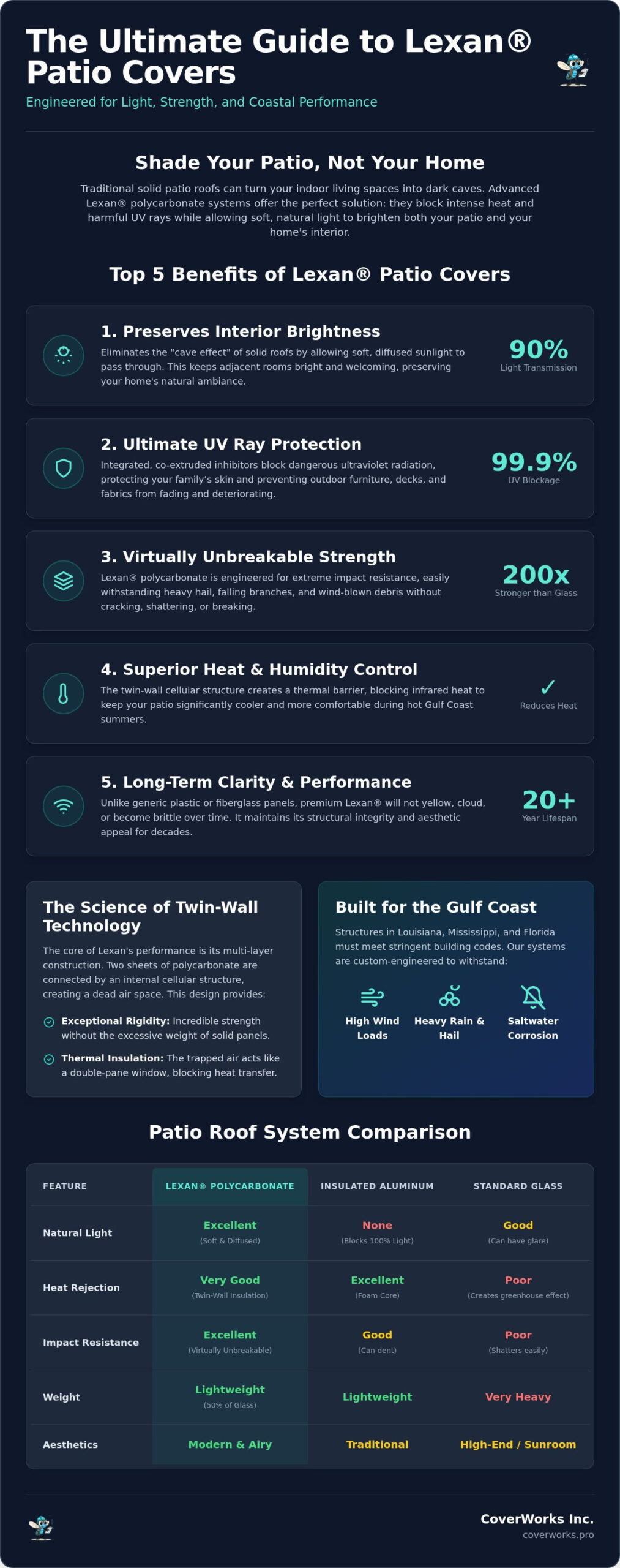
    What if you could shade your patio without plunging your home into total darkness? Most homeowners along the Gulf Coast, from New Orleans to Gulfport, deal with a frustrating trade-off: they install a solid roof for relief from the sun, only to find their indoor living areas turned into gloomy, shadow-filled spaces. Understanding the lexan patio cover benefits allows you to break this cycle. These engineered systems use advanced polycarbonate technology to filter natural light while rejecting the intense infrared heat that makes Southern summers so challenging. It’s the most effective way to stay dry and protected without sacrificing the airy, bright feel of your home.

    We’ll explore how twin-wall construction provides a thermal barrier that manages humidity more effectively than traditional glass or fiberglass. You’ll also learn about the structural engineering required to meet strict wind load standards in coastal Louisiana and Mississippi. Whether you’re concerned about hail durability or simply want a modern aesthetic that lasts for decades, this guide provides the technical insights needed to make an informed decision for your outdoor space. From custom aluminum framing to integrated UV protection, discover why Lexan is the gold standard for high-performance outdoor living.

    Key Takeaways

    • Understand why Lexan is the premium standard for impact resistance, offering a virtually unbreakable roofing solution that far outperforms standard plastic panels.
    • Explore the primary lexan patio cover benefits, specifically how these systems block 99.9% of harmful UV rays while keeping your home’s interior bright and naturally lit.
    • Learn how the unique twin-wall cellular structure provides essential thermal insulation to manage the intense Gulf Coast heat and humidity.
    • Discover why custom engineering is critical for meeting local building codes and ensuring your structure can withstand high wind loads in Louisiana and Mississippi.
    • Compare polycarbonate systems with insulated aluminum roofs to determine which material best fits your vision for a modern, airy outdoor living space.

    What is a Lexan Patio Cover? High-Performance Roofing Explained

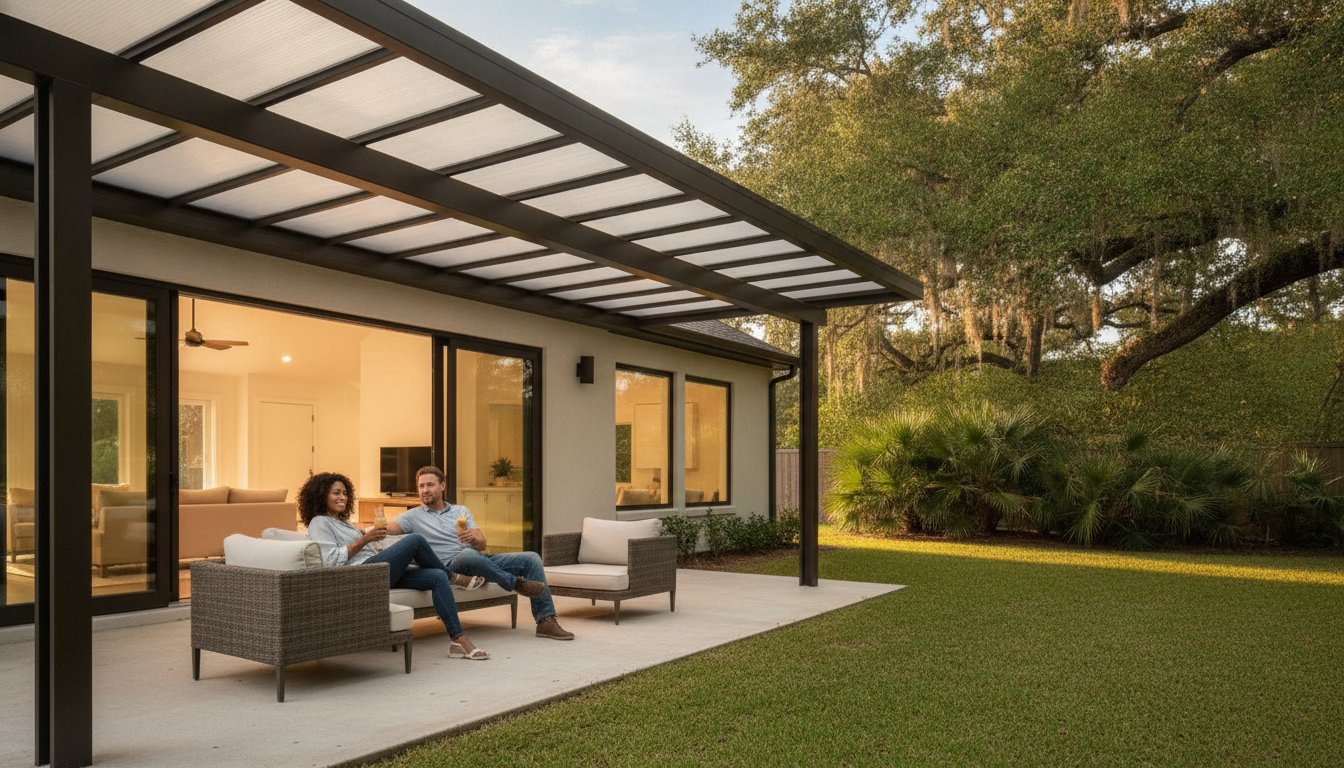
    A Lexan patio cover isn’t just a basic plastic roof; it’s a sophisticated architectural system designed for maximum durability. Lexan is a premium brand of Polycarbonate resin that has become the gold standard in the construction industry for its extreme impact resistance. Unlike the old corrugated fiberglass panels that many homeowners in New Orleans or Metairie remember from decades ago, these modern systems won’t yellow, crack, or become brittle under the harsh Southern sun. One of the primary lexan patio cover benefits is its ability to filter natural light. It allows a soft, diffused glow to reach your patio and the interior of your home, effectively eliminating the dark, cave-like feel created by solid aluminum or wood covers.

    Lexan vs. Generic Polycarbonate: What Is the Difference?

    While many contractors use the terms interchangeably, Lexan represents a specific high-grade resin with superior clarity and longevity. Generic polycarbonate often lacks the sophisticated, co-extruded UV inhibitors found in Lexan-based systems. These inhibitors are integrated directly into the material during manufacturing, ensuring the panels stay clear for decades rather than just a few seasons. Because it’s a premium product, it often carries a more robust structural warranty against breakage from hail or falling debris. For homeowners in Slidell or Mandeville who deal with frequent summer storms, this brand-name reliability provides peace of mind that generic alternatives simply can’t match.

    The Science of Twin-Wall Technology

    The secret to the performance of these roofs lies in the twin-wall structure. Instead of a single solid sheet, the panels consist of two layers of material connected by a cellular core. This design creates a dead air space between the walls that acts as a powerful thermal barrier. It works similarly to a double-pane window, significantly reducing the amount of heat transferred to the area below. This structure also provides incredible rigidity without adding excessive bulk. In fact, Lexan is 200x stronger than glass while weighing only half as much. This incredible weight-to-strength ratio allows us to design sleeker, more modern structures that can still withstand the heavy wind loads required by building codes across the Gulf Coast, from Kenner to Biloxi. Understanding these lexan patio cover benefits helps you see why this material is the professional’s choice for a high-end, long-lasting outdoor living space.

    The Top 5 Benefits of Lexan Patio Covers for Your Home

    Choosing a patio cover involves more than just picking a roof for shade. It’s about how you’ll experience your outdoor space every day. The specific lexan patio cover benefits go beyond mere shelter, offering a high-performance solution that enhances your home’s value and your daily comfort. For homeowners in cities like New Orleans and Gulfport, where the sun is relentless and storms are frequent, these systems provide a level of versatility that solid covers simply can’t match. They transform a standard patio into a bright, protected sanctuary that feels like a natural extension of your indoor living area.

    Protecting Your Interior Light Levels

    One of the biggest complaints we hear from homeowners in Metairie and Kenner is the “cave effect” caused by solid aluminum or wood patio roofs. While these structures provide shade, they often turn the adjacent indoor rooms into dark, gloomy spaces. Lexan eliminates this problem by allowing high levels of natural light transmission. This diffused light creates a soft, shadow-free environment that’s perfect for reading or dining without the harsh glare of direct sun. It also ensures that your indoor plants near patio doors continue to thrive, receiving the light they need while you stay cool under the cover.

    While the light comes through, the danger stays out. These panels block 99.9% of harmful UV rays. This is critical for protecting your family’s skin and preventing your outdoor furniture, rugs, and cushions from fading or becoming brittle. It’s the best of both worlds: the brightness of an open sky with the safety of a high-tech barrier.

    Durability Against the Elements

    Lexan impact resistance is defined by its ability to withstand heavy hail and wind-blown debris without shattering, making it a superior choice for coastal safety. This virtually unbreakable quality is why LEXAN™ polycarbonate is the preferred material for high-exposure areas in Slidell and Mandeville. Unlike budget plastics that cloud or become brittle over time, these panels maintain their structural integrity and clarity for decades. Maintenance is remarkably simple; usually, a quick rinse with a garden hose is all it takes to keep the structure looking new. There’s no need for the constant painting or staining required by wood structures.

    Heat management is another area where lexan patio cover benefits really shine. The twin-wall design, often combined with specialized heat-shield coatings, significantly reduces solar heat gain. You get the visual openness of a glass roof without the “greenhouse” temperature spike that makes most glass rooms unbearable in the Louisiana humidity. Finally, the modern look of these covers is undeniable. They offer a sleek, low-profile aesthetic that pairs perfectly with our custom aluminum framing. If you’re ready to see how these benefits apply to your specific backyard, you can request a professional design consultation to explore your options.

    Built for the Gulf Coast: Heat, Humidity, and Hurricane Resistance

    Living on the Gulf Coast means your home must withstand some of the most demanding environmental conditions in the country. Between the relentless humidity of New Orleans and the high wind speeds of Biloxi, standard construction materials often fail within a few years. One of the greatest lexan patio cover benefits is the material’s natural resistance to corrosion and moisture. When we pair high-grade Lexan with a structural aluminum frame, we create a system that won’t rust, rot, or harbor mold. This combination is specifically engineered to handle the unique stressors of the Deep South, ensuring your investment remains structurally sound even as the barometer rises.

    Managing the Southern Heat

    Many homeowners worry that a translucent roof will create a “greenhouse effect,” trapping heat on their patio. Modern Lexan technology actually solves this problem through advanced light management. These panels are designed with a low Solar Heat Gain Coefficient (SHGC), which is a technical way of saying they let in visible light while reflecting a significant portion of the infrared heat. Instead of the air becoming stagnant and hot, the diffused light keeps the area bright while the twin-wall core acts as an insulator. To maximize comfort during a humid Metairie afternoon, we often recommend integrating outdoor-rated ceiling fans into the aluminum support beams. This creates consistent airflow that, when combined with the heat-reflective properties of the roof, keeps the space significantly cooler than an open deck.

    Engineering for Storm Season

    In our region, a patio cover must be more than just a sunshade; it has to be a hurricane-resistant structure. We design every project to meet or exceed local building codes, including the strict wind load requirements found in the 9th Edition of the Florida Building Code. This involves precise calculations for uplift and shear forces. We often utilize structural styles like the Mansard roof, which uses multiple angles to deflect wind and provide superior rigidity. Professional engineering is non-negotiable here. A DIY kit might look fine on a calm day, but it lacks the heavy-duty anchoring and structural attachments needed to prevent panels from blowing out during a storm. By prioritizing code compliance and structural integrity, we ensure that the lexan patio cover benefits include long-term safety for your family and your property. Whether you’re in Mandeville, Slidell, or Kenner, your outdoor living space should be a place of refuge, not a liability when the weather turns.

    Lexan Patio Cover Benefits: The Ultimate Guide for Gulf Coast Homeowners

    Choosing Your Style: Lexan vs. Insulated vs. Glass Rooms

    Selecting the right roof system for your home in New Orleans or Biloxi depends entirely on how you intend to use your outdoor space. While we have detailed the specific lexan patio cover benefits regarding light transmission, other systems serve different functional needs. For instance, homeowners who want maximum shade and a more “indoor” feel often lean toward insulated aluminum roof panels. These are constructed from high-density foam sandwiched between aluminum skins, providing the best possible heat rejection. They are also the ideal choice if you plan to convert your patio into a screened-in room or a finished sunroom later.

    Feature Lexan Polycarbonate Insulated Aluminum Glass Room
    Natural Light High (Diffused) None (Total Shade) High (Direct)
    Heat Block Excellent (Reflective) Maximum (Insulated) Variable (High Gain)
    Impact Resistance Extreme (Hurricane Grade) High (Structural) Moderate (Glass Risk)
    Best Use Case Modern Patios / Gardens Future Screen Rooms Year-Round Living

    For those seeking a more traditional and cost-effective solution, non-insulated aluminum patio covers remain a rugged, durable option. These “pan roofs” are built to last for decades and require almost zero maintenance, though they don’t offer the thermal insulation or light-filtering properties of other systems. If your primary goal is to keep a vehicle or a utility area dry, this is often the most practical choice. It provides a permanent, structural alternative to temporary carports that often fail during high winds in Mandeville or Slidell.

    Finally, glass rooms represent the high-end, four-season solution. These structures allow for full climate control, meaning you can enjoy your view even when the Louisiana humidity is at its peak. However, glass is significantly heavier and requires a more substantial foundation and framing system. When comparing these options, remember that lexan patio cover benefits include a middle ground: you get the visual clarity of glass without the immense weight or the risk of shattering during a storm.

    When to Choose a Translucent Lexan Roof

    North-facing patios are often the best candidates for Lexan systems. Because these areas receive less direct sunlight, a solid roof can make the back of your house feel dark and uninviting even in the middle of the day. A translucent roof keeps these areas bright and usable year-round. This system is also the perfect choice for homeowners with extensive container gardens. Your ferns, tropicals, and seasonal flowers will receive the filtered light they need to thrive without being scorched by direct UV rays. From an architectural standpoint, the clean lines of polycarbonate panels complement modern and minimalist home designs better than traditional corrugated materials.

    Comparison of Maintenance and Longevity

    Longevity is a major factor when building in the Gulf Coast’s salt air and high humidity. Aluminum structures, whether paired with Lexan or insulated panels, easily offer a 20 plus year lifespan. This far exceeds wood, which inevitably rots, warps, or attracts termites in our climate. If you’re weighing your material options more broadly, our detailed breakdown of aluminum vs wood pergola maintenance reveals the true long-term costs of each choice for Gulf Coast homeowners. Maintenance for Lexan is also considerably lower than glass. While glass requires frequent cleaning to stay streak-free, Lexan’s specialized coatings help shed dirt and debris. Most homeowners find that a simple rinse with a garden hose once or twice a year is sufficient. If you’re struggling to decide which material fits your backyard best, you can get a free estimate and professional site evaluation from our team to compare these systems in person.

    The CoverWorks Difference: Custom Engineering and Local Expertise

    Over the last 25 years, CoverWorks Inc. has established itself as the premier aluminum specialty contractor for Louisiana, Mississippi, and Alabama. We’ve seen firsthand how generic, one-size-fits-all patio kits fail when faced with a Gulf Coast hurricane or the relentless humidity of a New Orleans summer. Our approach is fundamentally different. We treat every project as a bespoke engineering challenge. By choosing a custom-built solution, you maximize the lexan patio cover benefits by ensuring the structure is perfectly integrated with your home’s existing architecture and local soil conditions. Our team takes pride in delivering results that aren’t just aesthetically pleasing but are structurally superior to anything found in a big-box store.

    Our Design and Engineering Process

    Our process begins with site-specific engineering. We don’t just guess at wind loads; we calculate them based on your specific location, whether you’re in the High-Velocity Hurricane Zones of Florida or the coastal plains of Biloxi. Every aluminum component is fabricated with precision to ensure a seamless fit that prevents leaks and structural rattling. We handle everything from the initial design and permitting to material procurement and final installation. This end-to-end management ensures that your Lexan and Twin-Wall Polycarbonate roof meets all local building codes, providing a permanent solution rather than a temporary fix. We never recommend shortcuts that compromise safety; instead, we prioritize structural integrity and long-term durability in every Metairie and Kenner backyard we transform.

    Start Your Outdoor Transformation Today

    We understand the local climate because we live here. We know the difference between a Mandeville thunderstorm and a Slidell tropical depression. This regional familiarity allows us to recommend the exact specifications needed for your outdoor living space to thrive. We invite you to explore our gallery of pool enclosures and patio covers to see the level of craftsmanship we bring to every jobsite. Our team is dedicated to providing efficient service, often offering fast installations and same-day quotes to help you start your project without delay. We value your time and expectations, moving through the consultation and construction phases with methodical precision.

    If you’re ready to experience the full range of lexan patio cover benefits, it’s time to consult with a master craftsman. We take personal responsibility for every structure we leave behind, ensuring it adds beauty and functional value to your property for decades. Contact CoverWorks for a same-day quote on your Lexan patio cover.

    Transform Your Backyard with a High-Performance Patio Cover

    Investing in a custom outdoor structure is about more than just adding shade; it’s about enhancing your lifestyle and protecting your property. By choosing a system that prioritizes natural light and structural durability, you eliminate the “cave effect” of solid roofs while gaining a space that stays cool in the Louisiana humidity. The primary lexan patio cover benefits include 99.9 percent UV protection and a virtually unbreakable roof that stands up to the heavy hail and high winds common across the Gulf Coast region.

    With over 25 years of field experience, CoverWorks Inc. provides the local expertise needed to navigate complex building codes in cities like New Orleans, Gulfport, and Biloxi. We ensure every project is site-engineered for the specific wind loads required in Louisiana, Mississippi, and Alabama. Our commitment to precision craftsmanship means you get a permanent structure that won’t rust, rot, or harbor mold. Take the first step toward a brighter, more comfortable outdoor living space by contacting our team of master craftsmen today.

    Request Your Same-Day Quote from CoverWorks Inc. We look forward to helping you build a structure that provides lasting beauty and reliable protection for your home.

    Frequently Asked Questions

    Do Lexan patio covers turn yellow over time?

    High-quality Lexan panels don’t turn yellow because they feature co-extruded UV-absorbing layers. This technology protects the polycarbonate from the sun’s harsh rays, ensuring the material remains clear and structurally sound for decades. Unlike cheap, old-school plastic panels that become brittle and discolored, professional-grade Lexan maintains its aesthetic appeal even in the intense sunlight and high humidity of New Orleans or Biloxi. It’s a permanent solution designed for long-term clarity.

    Are Lexan patio covers noisy when it rains?

    Lexan patio covers are surprisingly quiet due to their twin-wall cellular structure. The dead air space between the layers acts as an acoustic insulator, dampening the sound of rainfall significantly more than single-sheet plastic or metal roofs. Most homeowners find the sound of rain on these panels to be a soft, muted patter rather than a loud or distracting noise. It provides a peaceful environment even during a heavy Metairie downpour.

    How much heat does a polycarbonate patio roof actually block?

    These roofs block a substantial portion of solar heat while allowing visible light to pass through. By utilizing specialized heat-shield coatings, Lexan panels can reflect infrared radiation, which is responsible for heat gain. This allows you to enjoy the full range of lexan patio cover benefits, such as a bright outdoor space that stays noticeably cooler. It creates a comfortable environment for dining or lounging without the temperature spikes seen under glass.

    Can a Lexan roof withstand heavy hail and falling branches?

    Lexan is virtually unbreakable and can easily withstand heavy hail and falling branches. The material is engineered to be 200 times stronger than glass and 30 times stronger than acrylic. This extreme impact resistance makes it a reliable choice for homeowners in storm-prone areas like Mandeville and Slidell. You won’t have to worry about shattering or dangerous shards during the frequent summer storms that roll through the Gulf Coast.

    Is Lexan better than glass for a patio cover?

    Lexan is often a superior choice for patio covers because it’s half the weight of glass and significantly more impact-resistant. It doesn’t require the massive structural foundations that glass rooms demand, making the installation process more efficient and cost-effective. Additionally, Lexan provides better UV protection and light diffusion. This prevents the “greenhouse effect” that often makes glass enclosures uncomfortably hot during a typical Louisiana summer afternoon.

    How do you clean and maintain a Lexan patio roof?

    Maintenance is remarkably simple and usually only requires a rinse with a garden hose once or twice a year. For more stubborn dirt, you can use a soft cloth or sponge with mild dish soap and lukewarm water. It’s important to avoid using abrasive cleaners or squeegees, as these can scratch the protective UV coating. Regular cleaning ensures the panels stay clear and continue to provide the light-filtering benefits you expect from a premium structure.

    Are Lexan patio covers hurricane-rated for the Gulf Coast?

    Yes, Lexan patio covers can be hurricane-rated when they’re custom-engineered for your specific location. At CoverWorks Inc., we design our structures to meet strict Gulf Coast wind load requirements, including the 9th Edition of the Florida Building Code. Proper anchoring and structural attachment are critical to ensuring the panels remain secure during high-velocity wind events. We prioritize code compliance to ensure your structure is safe and durable for years to come.

    Can I add a ceiling fan to a Lexan patio cover?

    You can easily add a ceiling fan to a Lexan patio cover by mounting it to the structural aluminum support beams. We integrate internal wiring channels into the frame to provide a clean, professional finish without exposed cables. Adding a fan is a great way to maximize the lexan patio cover benefits by increasing airflow. This keeps your outdoor living space comfortable and usable even when the humidity is at its peak in Kenner or Gulfport.