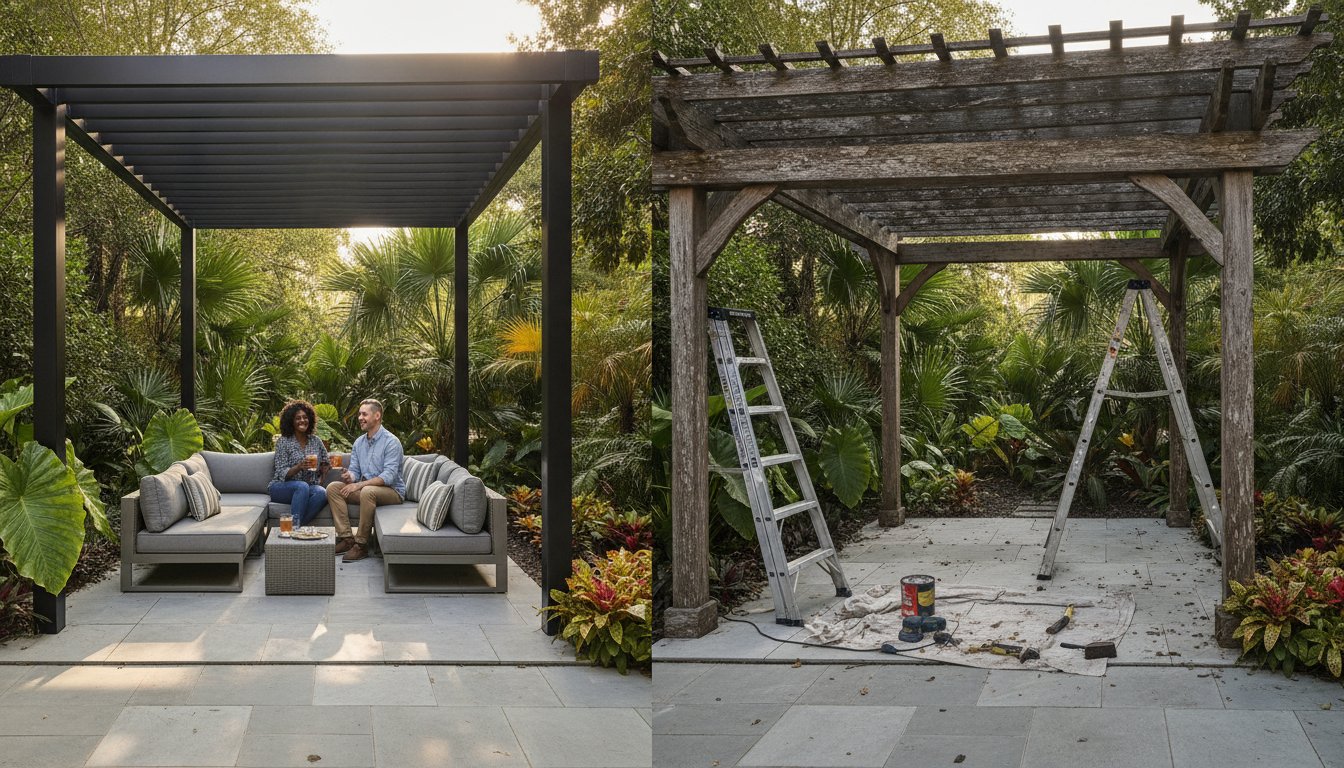
Did you know that a wood pergola costing significantly less upfront can actually end up costing you thousands more over its lifespan due to the brutal Gulf Coast climate? While the natural look of cedar or pine is appealing, the reality of aluminum vs wood pergola maintenance often comes as a shock to homeowners in New Orleans, Gulfport, and Slidell. You shouldn’t have to choose between a beautiful backyard and your free time. We understand that you want an outdoor structure that enhances your lifestyle rather than adding to your chores list.
This 2026 comparison reveals the hidden costs of wood rot and the increasing threat of invasive Formosan termites, which are now established in most coastal counties. You’ll discover how modern aluminum engineering meets the strict 9th Edition Florida Building Code standards and provides a 20 year solution that stands up to humidity and hurricane-force winds. We’ll examine the total cost of ownership and real-world labor requirements so you can make an informed investment for your home. By looking past the initial price tag, you can ensure your patio remains a place of relaxation instead of a source of structural worry.
Key Takeaways
- Understand the rigorous 12 to 24 month cycle of sanding, cleaning, and staining required to prevent wood structures from warping in 90% humidity.
- Compare the long-term aluminum vs wood pergola maintenance requirements to see how powder-coated finishes eliminate the need for recurring chemical sealing.
- Evaluate the true 10 year cost of ownership, where professional labor for wood upkeep often exceeds the initial investment of a premium aluminum structure.
- Learn why the spread of invasive Formosan termites across Louisiana and Mississippi makes wood pergolas a significant structural liability for homeowners.
- Discover how proper engineering and building code compliance ensure your shade structure is built to withstand Gulf Coast wind loads and severe storms.
The Reality of Wood Pergola Maintenance: A Yearly Commitment
A pergola provides an excellent architectural focal point for any backyard, but if it’s constructed from wood, that aesthetic comes with a heavy labor price. In the humid environment of the Gulf Coast, natural materials are under constant attack from moisture and heat. When homeowners weigh the pros and cons of aluminum vs wood pergola maintenance, the most immediate difference is the recurring labor cycle. Wood requires a hands-on approach every 12 to 24 months to keep it from becoming a structural liability.
Even pressure-treated lumber isn’t immune to our local elements. While factory treatments help deter some insects, they don’t stop the wood from absorbing atmospheric moisture. High humidity in communities like Metairie and Slidell causes wood fibers to expand and contract daily. Without a fresh chemical seal, this cycle leads to warping, twisting, and deep cracks known as checking. Maintaining a wood structure involves more than just a quick rinse; it requires a deep commitment to preserving the material’s integrity.
Sanding and Staining: The Weekend Warrior’s Burden
The preparation process for aged wood is grueling and time-consuming. You can’t simply apply a new coat of stain over the old layer. You must power wash the structure, wait for it to dry completely, and then sand down the raised grain to ensure the new sealant adheres properly. UV rays in the South are particularly aggressive. They break down the lignin in wood faster than in northern climates, causing the fibers to turn brittle. Skipping even one year of this maintenance allows the wood to take on a permanent, weathered gray tone that’s nearly impossible to reverse without aggressive sanding.
Structural Integrity and Rot Prevention
Maintenance is about safety just as much as it’s about looks. Wood joints are notorious for trapping moisture, which creates a breeding ground for internal rot that often goes unnoticed until a component fails. You’ll need to inspect headers and posts regularly for soft spots. In the Gulf Coast, ground-contact rot is a major concern at the base of the structure where water pools after a heavy rain. Since wood is a dynamic material, it also shrinks as it ages. This means you’ll find yourself frequently tightening bolts and hardware to keep the structure from swaying during high-wind events.
- Premium oil-based stains and water-repellent sealants
- High-quality brushes, rollers, and specialized sanding pads
- Pressure washing equipment rentals and cleaning solutions
- Rising professional labor fees for multi-day restoration projects
Choosing wood means accepting a lifestyle of ongoing chores. For those in New Orleans or Biloxi who want to spend their weekends relaxing rather than scraping old finish off a beam, the labor requirements of wood can quickly overshadow its initial charm. Understanding these demands is the first step in deciding which material truly fits your long-term goals for your outdoor living space.
Aluminum Pergola Maintenance: The ‘Set It and Forget It’ Alternative
While wood requires a relentless cycle of sanding and staining, aluminum offers a starkly different experience. High-grade structural aluminum is engineered to endure the harsh UV rays and salt spray of the Gulf Coast without degrading. When analyzing aluminum vs wood pergola maintenance, the most significant advantage is the material’s chemical stability. Aluminum doesn’t rot, warp, or invite pests, making it a permanent addition to your home rather than a temporary project. For homeowners in New Orleans or Slidell, this means reclaiming dozens of weekend hours every single year.
Aluminum naturally forms a protective oxide layer if the surface is ever compromised. This prevents the structural corrosion common in steel or the cellular breakdown found in wood. This inherent resistance is crucial for properties along the Mississippi Sound where salt air accelerates the decay of lesser materials. You aren’t just buying a shade structure; you’re investing in a material that is fundamentally compatible with a maritime climate.
The Power of Powder Coating
Unlike wood, which needs a new layer of protection every two years, aluminum utilizes a factory-applied powder coating. This finish is electrostatically applied and cured under heat to create a hard, durable skin. It bonds at a molecular level, providing superior color retention and resistance to chipping or peeling. This technology is a primary reason why aluminum is the preferred material for modern aluminum pergola designs in high-corrosion areas like Biloxi and Gulfport. Traditional paint on wood eventually cracks as the material expands and breathes, but powder-coated aluminum remains dimensionally stable through every heat wave.
Minimal Upkeep Tasks for 2026
Maintenance for an aluminum structure is mostly a matter of basic hygiene. You won’t need specialized chemicals, power sanders, or heavy machinery. Instead, the focus remains on keeping the structure clear of environmental buildup. A simple seasonal routine ensures the structure looks as good as the day it was installed. We recommend a few quick checks to maintain the integrity of the system.
- Seasonal rinsing: Use a standard garden hose to wash away environmental dust, pollen, or salt residue that can dull the finish over time.
- Gutter maintenance: If you have a louvered or solid-roof model, clear out leaves or pine needles to ensure the integrated drainage systems function correctly during heavy downpours.
- Fastener inspections: After major wind events, a quick visual check of structural fasteners ensures everything remains tightened to engineered specifications.
- Surface cleaning: Wiping down the posts with a soft cloth and mild soap every few months is usually enough to restore the factory shine.
By choosing a material that doesn’t demand your labor, you shift your focus from home upkeep to home enjoyment. If you’re ready to upgrade your outdoor space with a durable solution, consulting with an aluminum specialist can help you choose a design that fits your property’s specific wind-load requirements.
10-Year Cost Comparison: Upfront Investment vs. Long-Term Expense
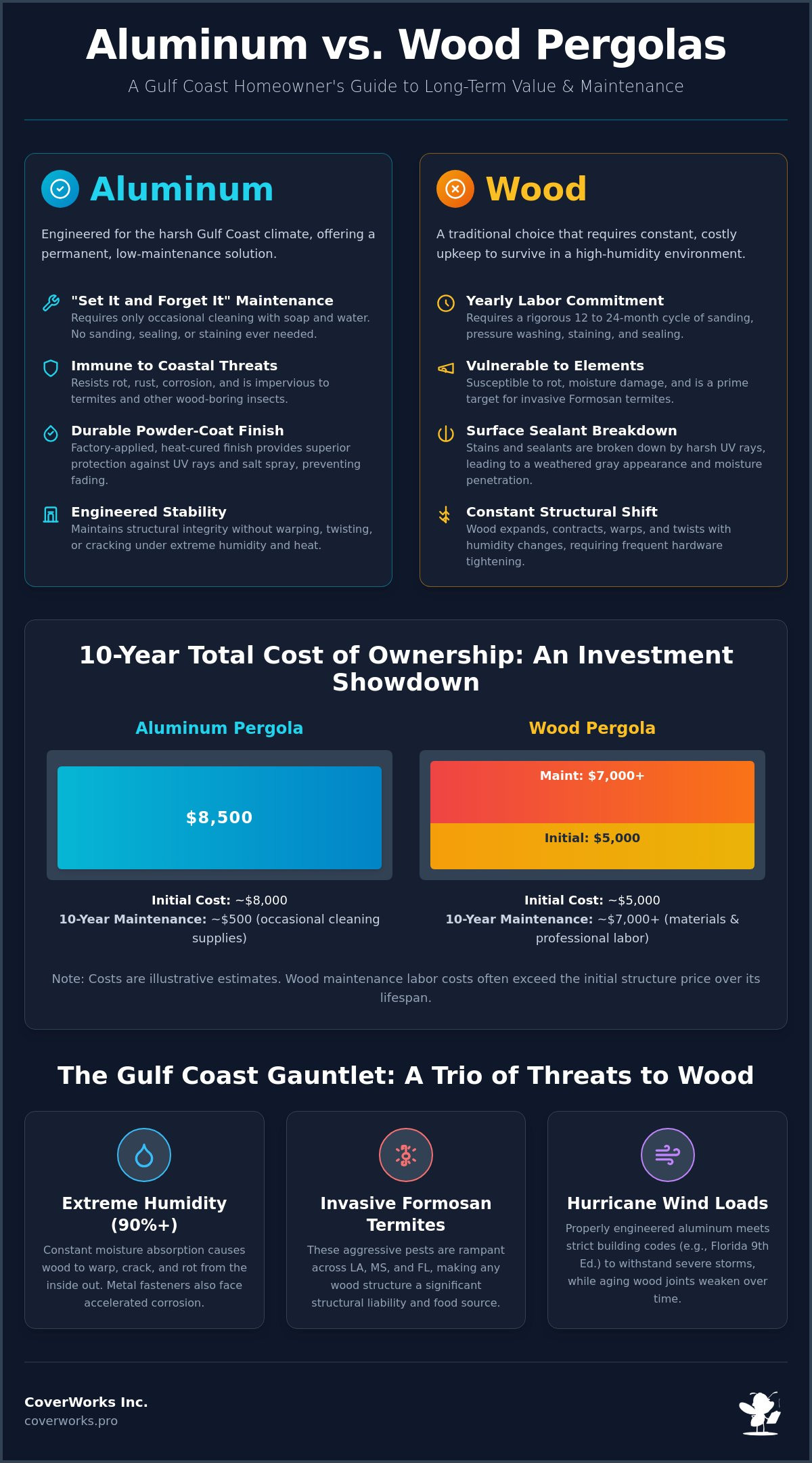
Many homeowners in the Gulf Coast initially lean toward wood because of the lower entry price. However, a responsible financial analysis of aluminum vs wood pergola maintenance requires looking at the total cost of ownership over a decade. While a cedar structure might save you money on day one, it essentially becomes a high-interest loan paid back in labor and materials every two years. In our humid climate, the “cheaper” option often becomes the most expensive over time.
Industry data from 2026 shows that a professionally installed wood pergola typically costs between $2,000 and $12,000 upfront. While this is often lower than structural aluminum, the savings disappear quickly once the maintenance cycle begins. In states like Louisiana and Mississippi, where UV exposure and moisture levels are extreme, the cumulative cost of professional staining and structural repairs can easily exceed $3,000 within the first decade. When you factor in that wood structures in the South often require full replacement after 15 years, the long-term value proposition shifts heavily in favor of aluminum.
The Wood Maintenance Bill
The financial burden of wood isn’t just about the stain itself. High-quality UV-rated sealants and professional labor rates in communities like Slidell and Metairie have continued to rise. If you choose the DIY route, you’re trading dozens of hours of your personal time for labor that must be repeated every 12 to 24 months. Wood owners also face the constant risk of termite damage. With the average termite repair bill hovering around $3,000, and homeowner’s insurance rarely covering the damage, a wood pergola can become a significant financial liability.
Aluminum Value Retention
Aluminum structures maintain a “like-new” appearance that directly impacts home appraisals. When it’s time to sell your property in New Orleans or Gulfport, an aluminum pergola is viewed as a permanent, maintenance-free asset rather than a future project for the buyer. This longevity is why aluminum is also a preferred choice for integrated lexan patio cover benefits and other high-performance structural systems. The same engineering principles that make pergolas resilient also apply to heavy duty aluminum carports, which offer Gulf Coast homeowners a permanent vehicle protection solution built to withstand the same wind loads and corrosive salt air.
- Zero costs for sanding, staining, or painting over a 30-year lifespan.
- Transferable warranties that add tangible value during home resale.
- Immunity to $3,000+ termite repair bills common in Texas and Florida.
- Engineered resilience that avoids the premature replacement costs of rotting wood.
By year five, the money saved on professional staining and chemical sealants often offsets the initial price difference. You aren’t just buying a structure; you’re buying back your future weekends and protecting your home’s equity. Choosing a material that doesn’t decay is the most effective way to ensure your outdoor investment remains an asset rather than a chore.
The Gulf Coast Factor: Termites, Humidity, and Hurricanes
Living on the Gulf Coast means dealing with 90% humidity levels that act like a slow-motion wrecking ball for organic materials. When homeowners analyze aluminum vs wood pergola maintenance, they often overlook how atmospheric moisture affects structural stability. Wood is hygroscopic; it constantly absorbs and releases water. This results in a relentless cycle of swelling and shrinking that loosens fasteners and creates deep internal cracks. Aluminum remains completely unaffected by these humidity swings, maintaining its dimensions and structural tightness for decades in cities like Biloxi and New Orleans.
In coastal Mississippi and Alabama, saltwater corrosion is another silent threat that demands specific material choices. By 2026, advanced aluminum alloys have become the standard for high-performance outdoor structures. These specific alloys are engineered to resist the pitting and oxidation that can plague lesser metals or untreated wood in maritime environments. Whether your property is in Gulfport or on the shores of Mobile Bay, choosing a material that doesn’t oxidize or rot is essential for long-term safety and aesthetic appeal.
Termite Resistance: A Non-Negotiable for the South
The 2026 termite swarm season has proven that invasive species like Formosan termites are spreading faster than ever across Louisiana and Mississippi. These pests don’t just damage your pergola; a wood structure attached to your home can act as a direct bridge for colonies to reach your main dwelling. Even wood species marketed as “termite-resistant” eventually lose their chemical potency in the Deep South’s extreme heat and rain. Aluminum is an inorganic material that offers zero nutritional value to pests. This provides a permanent, pest-proof barrier that protects both your outdoor living space and your home’s foundation without the need for toxic soil treatments.
Storm Readiness and Structural Integrity
Structural integrity isn’t just about durability; it’s about life safety during a hurricane. The 9th Edition of the Florida Building Code, which takes effect in late 2026, emphasizes stricter wind-load standards like ASCE 7-22 to better handle increased wind pressures. Aluminum’s superior strength-to-weight ratio makes it the ideal choice for meeting these rigorous requirements without overloading your home’s existing fascia or foundation. At CoverWorks Inc., we prioritize proper engineering and permitting for every project in communities like Metairie and Slidell. We ensure that every connection point is designed to withstand real-world Gulf Coast wind pressures, prioritizing building code compliance over cheap shortcuts.
Don’t leave your property’s safety to chance with a material that weakens and decays over time. If you’re concerned about how your outdoor space will handle the next storm season, contact CoverWorks Inc. for a professional structural inspection to evaluate your options and ensure your home is protected.
Conclusion: Choosing the Right Pergola for Your Lifestyle
Deciding on a material for your outdoor space is about more than just the initial appearance. When you weigh aluminum vs wood pergola maintenance, you’re really choosing how you want to spend your time and money over the next two decades. Wood offers a traditional look but demands a high-maintenance lifestyle that includes recurring chemical treatments and structural inspections. Aluminum provides a modern, resilient alternative that stays beautiful without the need for a single paintbrush or sander. Based on our 25 years of construction experience across the Gulf Coast, the choice usually comes down to whether you want a backyard project or a backyard retreat.
One critical factor often ignored in generic comparisons is how the material affects your home’s structural attachment points. Wood pergolas attached to your house fascia are notorious for trapping moisture at the ledger board. In humid cities like New Orleans and Metairie, this can lead to rot in your home’s actual framing. Aluminum systems are engineered with precision flashings and non-porous materials that protect your home’s envelope. This difference alone can save you from expensive structural repairs that have nothing to do with the pergola itself. Choosing a material that doesn’t hold moisture is a proactive way to protect your largest investment.
Is Aluminum Right for You?
Assessing your backyard goals requires a balance between aesthetics and long-term functionality. If you value a “set it and forget it” approach that withstands the 130 mph wind loads common in Gulfport and Biloxi, aluminum is the clear winner. The installation process is also far more efficient; our crews can often complete a project in a fraction of the time required for a custom wood build. Working with an experienced screen room contractor in Alabama ensures that your structure is permitted correctly and built to the latest 2026 building codes. We prioritize precision over speed, ensuring every connection is secure.
Get Your Custom Estimate Today
At CoverWorks Inc., our decades of field experience in Louisiana and Mississippi have taught us that structural integrity is non-negotiable. We don’t believe in shortcuts or temporary fixes that might compromise your safety during a storm. Every pergola we install is custom-engineered to meet local wind loads and salt-air corrosion standards. Whether you’re in Slidell or on the shores of Mobile Bay, we provide site-specific consultations to ensure your new shade structure is a permanent asset to your property.
- Precision Engineering: Every structure is designed for regional wind load compliance.
- Durable Finishes: Our powder-coated aluminum resists the 90% humidity of the Gulf Coast.
- Expert Installation: We handle the permitting and structural attachments with professional care.
- Long-Term ROI: Eliminate the $300 to $500 annual maintenance costs associated with wood.
Don’t settle for a structure that will eventually rot or invite termites. Contact CoverWorks Inc. today to schedule your site-specific engineering consultation and receive a free quote for a maintenance-free aluminum pergola that is built to last a lifetime.
Build a Legacy of Comfort in Your Outdoor Space
Choosing between materials is ultimately a decision about your future weekends. While wood offers a traditional aesthetic, the reality of aluminum vs wood pergola maintenance shows that structural aluminum is the only choice for long-term peace of mind in our humid climate. You can avoid the relentless cycle of staining and the threat of Formosan termites by opting for a material specifically engineered for the Gulf Coast.
At CoverWorks Inc., we bring over 20 years of regional experience to every project. We specialize in hurricane-ready engineering that meets the latest building codes in New Orleans, Gulfport, and Biloxi. We prioritize structural integrity so your investment stands strong against the elements. If you’re ready to transform your patio into a maintenance-free retreat, we’re here to help with same-day quotes. Request Your Free Pergola Estimate from CoverWorks Inc. Today
We look forward to helping you create a beautiful, durable outdoor space that your family will enjoy for decades to come.
Frequently Asked Questions
Is an aluminum pergola really maintenance-free?
Aluminum pergolas are considered maintenance-free because they do not require the recurring structural treatments that wood does. You will never need to sand, stain, or seal the material to prevent rot or warping. The only upkeep involved is a seasonal rinse with a garden hose to remove environmental debris, pollen, or salt spray. This simplicity is a major factor in the aluminum vs wood pergola maintenance debate for busy homeowners.
How often does a wood pergola actually need to be stained in the South?
In the intense humidity and UV exposure of the Gulf Coast, a wood pergola typically requires staining and sealing every 12 to 24 months. Skipping this cycle allows moisture to penetrate the fibers, leading to graying and structural decay. Homeowners in cities like New Orleans often find that the professional labor costs for this recurring task quickly add up, making wood a more labor-intensive long-term commitment than aluminum.
Do aluminum pergolas rust if I live near the Gulf of Mexico?
Aluminum does not rust because it contains no iron. While lesser metals might corrode in salt-air environments like Gulfport or Biloxi, high-grade structural aluminum utilizes a protective powder-coated finish that resists oxidation. This makes it an ideal choice for coastal properties where salt spray would quickly degrade steel or rot untreated wood. It maintains its structural integrity even in high-moisture maritime conditions.
Can I paint an aluminum pergola if I want to change the color later?
While you can technically paint aluminum, we generally advise against it because factory-applied powder coating is far more durable than traditional paint. The original finish is bonded to the metal at a molecular level to prevent chipping and peeling. If you decide to change the color later, it requires extensive surface preparation and specialized primers to ensure the new coat adheres properly to the smooth, non-porous surface.
Which pergola material is better for high-wind and hurricane zones?
Aluminum is the superior choice for hurricane-prone regions because it is engineered to meet specific wind-load requirements without the weight of heavy timber. Modern aluminum structures are designed to comply with the 9th Edition Florida Building Code and ASCE 7-22 standards. Unlike wood, which can weaken as it rots or develops cracks, aluminum maintains its full structural strength and fastener tightness during severe storm events.
What is the lifespan of an aluminum pergola compared to pressure-treated wood?
An aluminum pergola typically lasts 30 years or more with almost no degradation in structural quality. In contrast, pressure-treated wood structures in the humid South often face significant rot or termite issues within 10 to 15 years. Even with meticulous upkeep, wood is a biological material that eventually succumbs to the elements, whereas aluminum is a permanent architectural addition to your home.
Does the color of an aluminum pergola fade in the intense Southern sun?
High-quality powder-coated finishes are specifically formulated with UV inhibitors to resist fading in the intense Southern sun. While all materials experience some microscopic changes over decades, the color retention of aluminum far exceeds that of wood stains or traditional paints. Your structure will maintain its vibrant, factory-finished look long after a wood pergola would have turned gray or required multiple restaining projects.
Are aluminum pergolas more expensive to install than wood?
Aluminum pergolas generally have a higher upfront installation cost than basic pressure-treated wood. However, when you factor in the aluminum vs wood pergola maintenance costs over ten years, aluminum often becomes the more affordable option. By eliminating the need for professional staining, chemical sealants, and eventual structural repairs, the initial investment typically pays for itself through long-term savings and increased property value.